The Elite Insurance Agency Sales Process: Scaling P&C Growth in 2026
- Aug 8
- 12 min read
Why are you still settling for a 24 month producer ramp up when the 2026 market is already shifting under your feet? With commercial property premiums falling by 5.5 percent, your agency cannot afford the financial drain of underperforming talent. You likely feel the weight of inconsistent sales results and the exhaustion of a team that relies entirely on your personal intervention to close deals. It's a common trap, but it's one that elite agencies have already escaped. This article demonstrates how to transform a stagnant workflow into a high-performance engine by implementing a sophisticated insurance agency sales process. You'll learn the exact framework to double producer output and slash breakeven time in half. We'll examine how to leverage AI coaching and fractional leadership to create a predictable revenue stream that scales without your constant oversight. It's time to stop managing mediocrity and start engineering elite performance.
Table of Contents
Why Your Current Insurance Agency Sales Process Is a Stagnation Trap
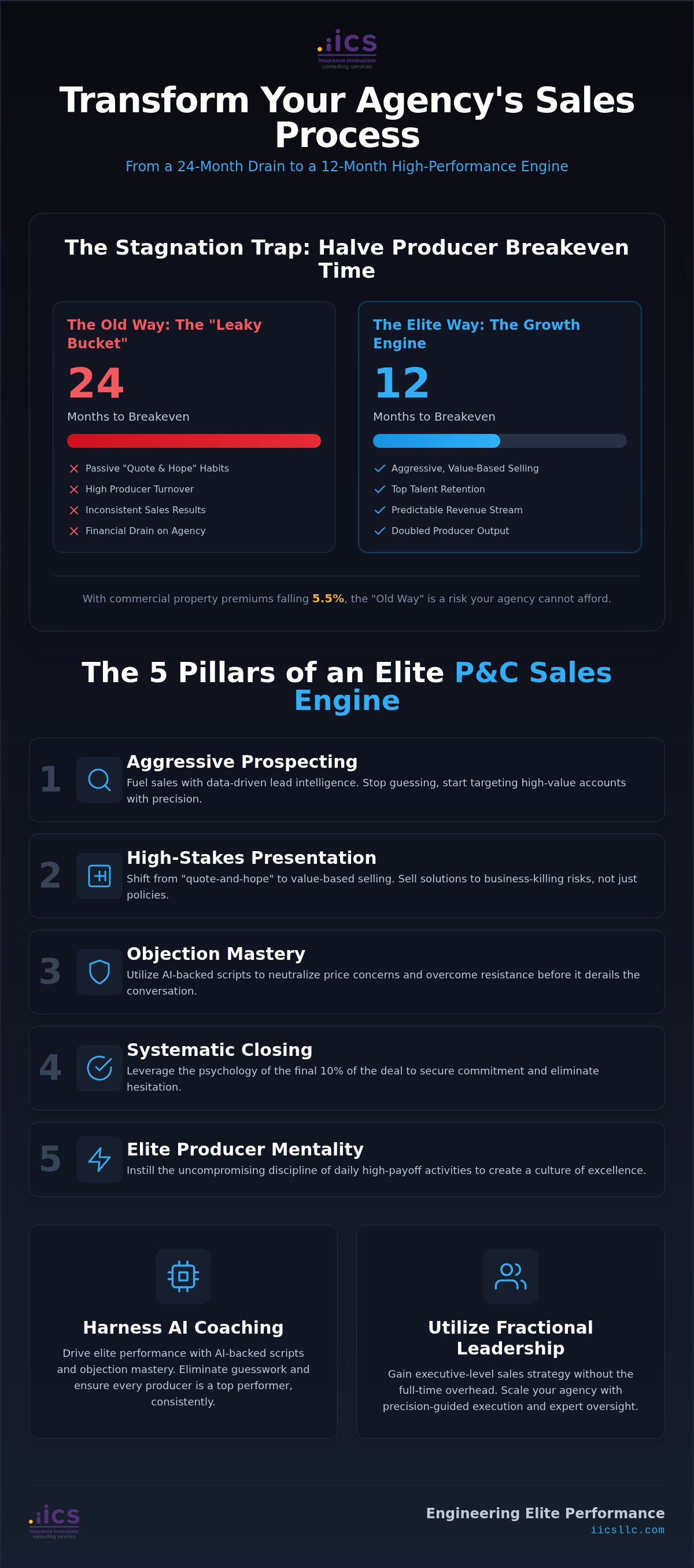
The 2026 P&C market is a battlefield where average performance is a slow death sentence. Commercial property premiums have fallen by 5.5 percent, and large accounts are seeing decreases of 2.7 percent. If your agency is relying on market hardening to pad your revenue, that era has ended. Most independent insurance agents are currently operating with a "leaky bucket" sales workflow. You hire a producer, give them a desk, and hope they figure it out. This lack of a documented, elite insurance agency sales process is why your producers take 24 months to reach breakeven. It's a financial drain that kills your agency's valuation before the ink on the contract even dries.
Your CRM is not a strategy. It's a database. Most teams treat their CRM like a digital filing cabinet because they haven't been given a methodology to follow. They spend their days reinventing the wheel every Monday morning instead of executing a battle-tested plan. A tool without a process is just expensive clutter. When your producers spend more time wondering what to do next than actually doing it, you're paying for their indecision. You aren't just losing money on salary; you're losing the market share your competitors are aggressively claiming while you're stuck in neutral.
The High Cost of Non-Producing Hires
What is the actual cost of a failed producer? It isn't just the salary you paid out over twelve months. It's the thousands of dollars in lost opportunity cost, the wasted management hours spent on "hope-based" coaching, and the subtle erosion of your agency's culture. When you rely on generic training, you're gambling with your capital. High turnover isn't a hiring problem; it's a structural failure. Top talent won't stay in a broken system. They want a framework that guarantees success. Without it, your best people will burn out or move to a competitor who actually has their act together.
The Stagnation Trap: Are You Growing or Just Surviving?
Are you actually winning new business, or are you just riding the wave of organic retention? Many agency owners confuse "not dying" with "growing." If your revenue is flat while global sector growth is projected at 4.7 percent, you're actually falling behind. Is your agency a high-performance machine or a comfortable hobby? You must decide if you want to be a market leader or a market statistic. The Stagnation Trap is the gap between your agency's theoretical potential and the actualized revenue your current insurance agency sales process produces. Breaking out of this trap requires a radical shift in how you view producer development and sales discipline.
The 5 Pillars of an Elite P&C Sales Engine
An elite insurance agency sales process isn't built on luck or personality. It's a precision-engineered system. Most agencies struggle because they treat sales like an art form rather than a repeatable science. To dominate in 2026, your engine must stand on five non-negotiable pillars. First, aggressive prospecting fueled by data-driven lead intelligence allows your producers to stop guessing and start targeting. Second, the high-stakes presentation moves the needle from "quote-and-hope" to value-based selling. You aren't selling a piece of paper; you're selling a solution to a business-killing risk. This is the fundamental shift required to move away from commodity-based competition.
The remaining pillars focus on execution and mindset. Pillar three involves objection mastery. By using AI-backed scripts, your team can neutralize price concerns before they derail the conversation. Pillar four is systematic closing, which leverages the psychology of the final 10 percent of the deal to ensure commitment and eliminate last-minute hesitation. Finally, pillar five is the elite producer mentality. This is the uncompromising discipline of daily high-payoff activities. Without these pillars, your agency isn't a growth machine. It's just a collection of people waiting for the phone to ring. If you want to see how these pillars integrate into a wider strategy, you should evaluate your current sales leadership structure.
Transitioning from Generalist to P&C Specialist
Niche expertise is the only way to win in Commercial Lines today. Generalists are being commoditized by algorithms and direct-to-consumer platforms. To stay relevant, your producers must become specialists who understand industry-specific pain points. While State insurance regulators set the baseline for compliance, they don't teach your team how to win high-stakes accounts. You need a battle-tested script that speaks the language of high-net-worth clients and complex business owners. Mastering advanced commercial insurance sales techniques allows your team to command respect and higher premiums by solving problems your competitors don't even see.
The Mechanics of Value-Based Outreach
Stop selling policies. Start selling risk mitigation and business continuity. Your outreach needs to pivot immediately. The first three minutes of a cold call are designed to earn the next thirty. If your producers lead with "saving money," they've already lost the high-value prospect. Value-Based Outreach is the pivot from price to performance. It’s about identifying a gap in a prospect's current coverage and showing them the financial consequences of inaction. You must train your producers to stop being "order takers" and start being risk consultants. This transition is the difference between a stagnant book of business and an agency that doubles its output every year.
Cutting Producer Ramp-Up Time in Half: The 90-Day Sprint
The industry standard for producer breakeven is a staggering 24 to 36 months. That's a massive financial liability for any agency owner. Why wait three years for a producer to pay for themselves? The IICS Methodology proves that a structured insurance agency sales process can slash that timeline in half. The first 90 days of a producer's career are the most critical. They don't just learn skills; they build the habits that will define their next decade. If you let them drift during this window, you're essentially subsidizing their eventual failure. You're paying for their education while they lose your prospects.
We use MicroLearning to prevent the information overload that typically kills new hires. Instead of drowning producers in technical manuals for weeks, we deliver high-impact, bite-sized training that sticks. This is supported by continuous feedback loops. Waiting for a monthly review to correct a bad habit is a growth killer. Real-time adjustments ensure that your producers are always moving forward, not repeating the same mistakes on every prospect call. It’s about precision, not just activity. If you aren't correcting mistakes the hour they happen, you're allowing mediocrity to take root in your agency.
The 3-Month Sales Academy Framework
Our 3-month Sales Academy is a tactical progression designed for rapid results. Month one focuses on foundation and technical mastery of P&C lines. We don't just teach policy details; we teach how those details solve client problems. Month two shifts to execution, outreach, and aggressive pipeline building. This is where the rubber meets the road. By month three, we're refining closing techniques, negotiation, and the elite performance habits that separate the top one percent from the rest of the pack. This isn't a suggestion; it's a battle-tested roadmap for dominance.
Doubling the Likelihood of Success
Data shows that structured academies produce twice as many "Top Producers" compared to traditional on-the-job training. It isn't a coincidence. It's the result of a rigorous environment and 1:1 call coaching that provides immediate, actionable insights. This level of intensity isn't for everyone, but it's the only way to build a high-growth firm in a softening market. For a comprehensive roadmap on this transition, review the Elite Insurance Producer Development Plan. You can't leave your agency's future to chance. You have to engineer it through discipline and superior systems.
Leveraging AI Coaching and Fractional Leadership for Scale
Scaling a high-growth insurance agency sales process requires more than just a thicker phone book. It demands a sophisticated leadership infrastructure that most agency owners simply don't have the time to build. You're likely already stretched thin, acting as the lead producer, the manager, and the visionary all at once. This is a recipe for a bottleneck. To break through, you must leverage two force multipliers: AI-driven technology and fractional elite leadership. These aren't just luxuries for the big shops. They're the survival tools for any agency that intends to thrive in a softening market.
Weekly Live Workshops and Effectiveness Tools ensure your team stays focused on High-Payoff Activities (HPAs). Busy work is the silent killer of profitability. Are your producers actually prospecting, or are they hiding in administrative tasks? Our tools measure what actually moves the needle, providing a level of transparency that forces performance. You can't manage what you don't measure. By focusing on the activities that drive revenue, you turn your insurance agency sales process from a reactive service center into a proactive sales engine.
AI-Driven Feedback: The New Competitive Advantage
AI isn't coming for your job; it's coming to make your producers better. By analyzing call sentiment and objection handling in real-time, AI provides the kind of instant coaching that a human manager simply can't match. It identifies exactly where a deal went sideways, allowing for immediate correction. This drastically reduces the coaching burden on agency principals. You no longer have to listen to hours of tapes to find one teachable moment. To understand how this technology is reshaping the industry, read about the future of AI sales coaching for insurance. It's about data-driven precision, not guesswork.
The Fractional Chief Revenue Officer (CRO) Model
Does your agency really need a $250,000-per-year sales leader? Probably not. What you need is elite strategy and uncompromising accountability. The Fractional CRO model allows you to outsource your sales leadership to a 40-year industry veteran for a fraction of the cost. There's a massive difference between a "Manager" who watches the clock and a "Growth Strategist" who builds a legacy. Fractional leadership provides the outside perspective and high-level discipline your producers are currently missing. If you're ready to stop playing small, it's time to explore our fractional CRO services and install an elite leadership structure today.
Transforming Your Agency into a Growth Machine with IICS
Transitioning from a stagnant agency to an elite growth machine requires more than a simple desire for change. It demands a systematic dismantling of your current, broken habits. The first step in this three-step transition is radical honesty. You must admit that your current insurance agency sales process is failing to produce the results you need. The second step is the installation of a battle-tested framework like the IICS Sales Academy. Finally, you must enforce a culture of uncompromising discipline. This isn't a "set it and forget it" solution. It's a continuous commitment to excellence that separates the market leaders from the also-rans. Are you ready to stop making excuses and start making progress?
Integrating the IICS Sales Academy into your 2026 growth plan is the fastest way to stabilize your revenue and outpace the competition. While others are reacting to premium fluctuations in the commercial property sector, you'll be building a proactive insurance agency sales process that generates its own momentum. The ROI on elite training is undeniable. When you slash producer ramp-up time in half, the investment typically pays for itself within the first six months. You aren't just buying training; you're buying back the time and capital usually wasted on failed hires. You're investing in a future where growth is predictable, not accidental.
Customizing the Framework for Your Agency
Every agency has a unique footprint, whether you specialize in high-risk construction, emerging tech, or complex manufacturing. Our framework isn't a rigid template; it's a flexible engine. You can adapt these elite principles to dominate your specific P&C niches and command higher retention rates. Long-term sustainability is achieved through the Insurance Agency Sales Performance Framework. This structure ensures that your team maintains high-payoff activities even as the market softens. Why settle for a generic approach when you can have a precision-tuned weapon? The "Elite" label is earned through discipline, not just desire.
Ready to Scale? Your 2026 Roadmap
What is your next move? You can continue to audit your current, failing process, or you can commit to elite performance. The first step on your 2026 roadmap is to schedule a consultation with IICS. We'll identify your biggest growth bottlenecks and show you exactly how to clear them. Once the path is clear, enroll your next hire in the 3-Month Sales Academy to guarantee a faster ramp-up and immediate results. Don't leave your agency's future to the mercy of the market. Take the first step toward becoming the dominant force in your territory today. Success is a choice. Make it.
Take Command of Your Agency's Growth Path
The 2026 P&C market rewards precision and punishes hesitation. You've seen how a broken insurance agency sales process drains your capital and stalls your producers. You now understand that an elite engine is built on data-driven prospecting, value-based selling, and a rigorous 90-day sprint. Stop letting your agency’s future be a matter of chance. You can't afford to wait years for a producer to finally pay for themselves while your competitors aggressively claim your market share.
With 40 years of industry-leading experience, we've perfected a methodology where graduates achieve breakeven revenue in 50 percent less time than the industry norm. By utilizing AI coaching and MicroLearning, we transform raw talent into high-performance producers who dominate their niches. You don't have to carry the burden of sales leadership alone. It's time to install the framework that guarantees predictable growth and uncompromising standards. You have the tools; now you need the discipline to execute.
Join the IICS Sales Academy and Double Your Producer Output. Your path to the top tier of the P&C market starts with a single, decisive action. We're ready to help you build your legacy and secure the growth your agency deserves.
Frequently Asked Questions
How long does it typically take to see results from a new insurance sales process?
You should expect to see behavioral changes and increased prospecting activity within the first 30 days. However, meaningful revenue growth typically materializes between 90 and 180 days as the pipeline matures. An elite insurance agency sales process focuses on high-payoff activities that generate immediate momentum. If you don't see a shift in your team's discipline almost immediately, your implementation lacks the necessary accountability.
What is the industry standard ramp-up time for a P&C producer?
The industry standard for a producer to reach breakeven is typically 24 to 36 months. This is an unacceptable drain on agency capital. Our methodology slashes this timeline in half by front-loading technical mastery and aggressive outreach. Waiting three years for a return on your investment isn't a strategy; it's a gamble. Elite agencies demand results much faster through structured, high-intensity development.
Can AI sales coaching really replace traditional 1-on-1 mentoring?
AI doesn't replace the mentor; it scales the mentor's expertise. While a principal can only listen to a handful of calls, AI analyzes every interaction for sentiment and objection handling. It provides the high-frequency feedback that traditional mentoring lacks. Think of AI as a 24/7 coach that ensures your producers never repeat a mistake twice. It frees you to focus on high-level strategy instead of basic skill correction.
What are the most common reasons why insurance sales processes fail?
Most processes fail because of a lack of uncompromising discipline and leadership accountability. A process that isn't measured is eventually ignored. When agency owners allow producers to drift back into "hope-based" selling, the system collapses. Failure also stems from using a CRM as a digital filing cabinet rather than a tactical tool. Without a culture that demands elite performance, even the best framework will gather dust.
How much does it cost to implement an elite producer development program?
You should view this as a strategic investment rather than a line-item expense. The cost of implementation is significantly lower than the sunk cost of a failed producer who washes out after 18 months. While specific investment levels vary based on agency size, the ROI is usually realized within the first six months. Consider the value of doubling your producer output and decide if you can afford to continue with a stagnant workflow.
Is outsourced sales leadership (Fractional CRO) right for a small agency?
Fractional leadership is often the only way for a small agency to access high-level strategy without a six-figure salary burden. A Fractional CRO brings the discipline of a 40-year veteran to your shop, providing the accountability your producers are currently missing. It's about buying the results, not the headcount. If you're a principal who is too busy to manage sales daily, this model is your only path to scaling.
What is the difference between a sales process and a sales cycle?
A sales cycle is the external timeline of the prospect's journey from initial contact to the final signature. In contrast, an insurance agency sales process is your internal, repeatable framework for moving that prospect through the cycle. One is what the buyer does; the other is what your producer executes with precision. You can't always control the cycle, but you must master the process to ensure a predictable outcome.
How do I handle producers who are resistant to a new, more disciplined process?
Standards are non-negotiable in an elite culture. You must communicate that the new process is the price of admission for staying at the agency. Resistance usually comes from those who fear their lack of activity will be exposed. Give them the tools to succeed, but don't apologize for demanding excellence. If a producer refuses to adapt after 90 days, they're likely a liability to your long-term growth.