The Elite Insurance Producer Compensation Plan: A 2026 Framework for Growth
- 4 days ago
- 11 min read
Why are you still financing a three-year "learning curve" that should only take eighteen months? Most agency owners have been conditioned to accept that a commercial P&C producer takes 36 months to validate. It's a lie that's costing you your best talent and your agency's valuation. If your current insurance producer compensation plan feels more like a charity than a growth engine, you're already behind. You know the frustration of watching top-tier talent walk out the door for a slightly better split while your remaining team coasts on renewals.
It doesn't have to be this way. You can structure your firm to reward elite performance and precise execution. This article provides the 2026 framework for a compensation model that aligns producer effort with agency profit. We'll explore tiered commission structures, the strategic gap between new and renewal business, and how to use data-driven incentives to build a culture of high-stakes success. It's time to stop hoping for growth and start engineering it.
Table of Contents
The High Cost of Misaligned Insurance Producer Compensation Plans
An insurance producer compensation plan is far more than a payroll schedule. It's a strategic framework designed to align individual incentives with the agency's long-term profitability and valuation. In 2026, the industry has shifted away from passive payout models. Agencies that thrive today use performance-accelerating structures that demand results. If your plan doesn't force growth, it's likely subsidizing stagnation. It's time to stop viewing compensation as an expense and start viewing it as a catalyst for elite performance.
Many owners suffer from what we call the "Heroics Tax." This occurs when you overpay underperformers in the hope they'll eventually turn a corner. It drains your growth capital. It starves your marketing budget. Most importantly, it creates a massive gap between industry-standard splits and the elite performance required to scale. While the foundational principles of insurance remain rooted in risk transfer, the greatest risk to your agency is a misaligned comp plan. Stop paying for potential that never materializes.
The Hidden Cost of the 36-Month Ramp-Up
The industry standard for producer validation is often cited as 36 months. That's a dangerous baseline. When a producer takes three years to reach breakeven, the agency absorbs a massive burn rate. You're covering salaries, benefits, and overhead while the revenue remains negligible. Most agencies don't realize a producer is failing until they're $100,000 in the red. This creates a toxic environment. Your top performers notice when the bar is set low. They'll eventually leave for competitors who value elite results over tenure. High-stakes talent won't stay in a culture that tolerates mediocrity.
Agency Valuation vs. Producer Payouts
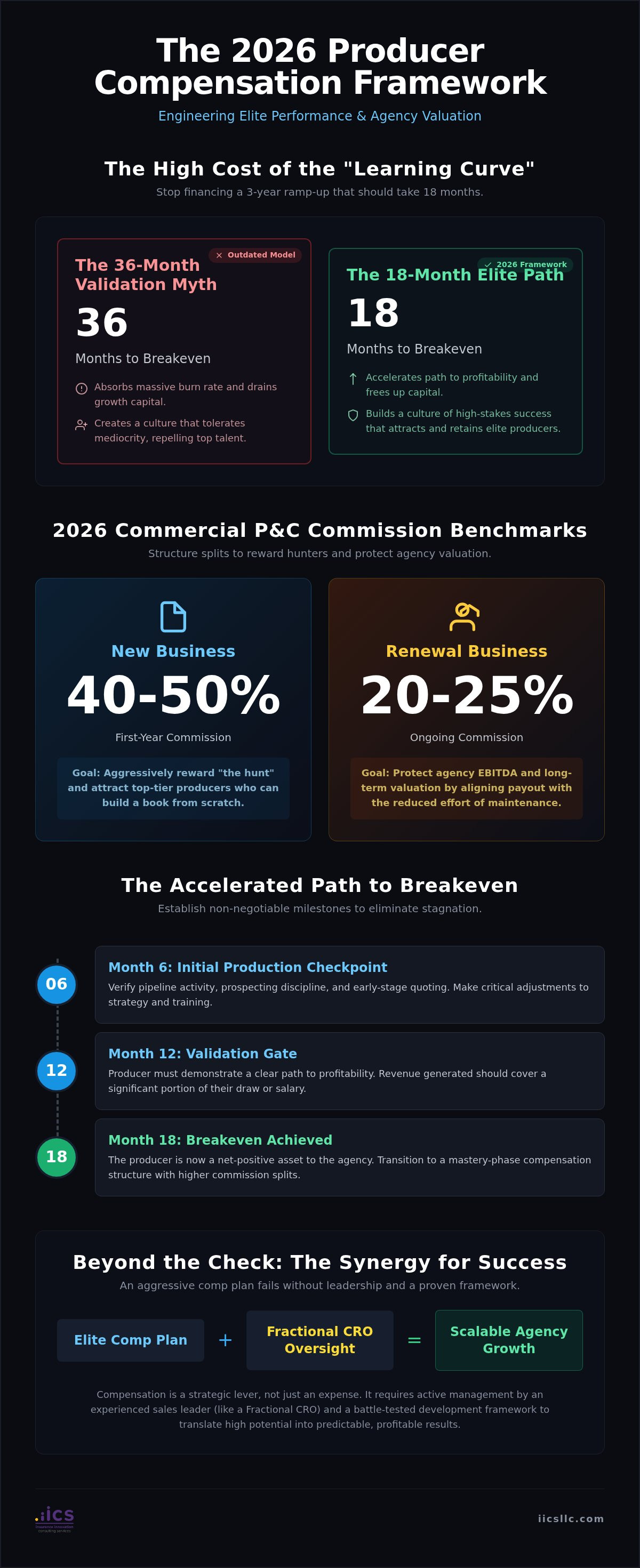
High renewal commissions are a valuation killer. If you're paying excessive splits on a book that requires little effort to maintain, you're actively lowering your agency's sale price. Potential buyers look for profitable EBITDA, not just high premium volume. You must balance producer retention with the necessity of a profitable book. In 2026, the sweet spot for P&C commission splits is 40% to 50% on new business with a sharp drop to 20% or 25% on renewals to protect the agency's terminal value. This structure rewards the hunter while ensuring the agency remains a valuable asset. Achieving this balance often requires a Fractional CRO to architect a plan that drives both immediate growth and long-term profit.
Core Compensation Models: From Straight Commission to Base-and-Growth
The architecture of your insurance producer compensation plan dictates the DNA of your sales team. You can't hire a Thoroughbred and feed it like a donkey. Choice of model is the first filter for talent. The Salary Plus Commission model provides a necessary safety net for elite development, particularly in the high-complexity world of commercial P&C. It allows a producer to focus on the long-game of mid-market accounts without the desperation of missing a mortgage payment. Conversely, straight commission attracts "sharks." While these individuals are often highly self-motivated, this model frequently leads to high churn if the agency's back-office support doesn't match the producer's risk level.
Many agencies utilize a Draw Against Commission to manage cash flow during the extended P&C sales cycle. It's essentially a loan against future success. While functional, it often creates a "debtor" mentality that can stifle a producer's creative aggression. Tiered structures offer a more sophisticated path. They reward the transition from an account-manager style of service to an elite hunter mentality. If your plan allows a producer to retire on their renewals, you aren't running an agency; you're running a pension fund. It's time to demand more.
The Base and Growth Method Explained
Setting a base salary requires precision. It should be high enough to ensure the producer isn't distracted by personal financial stress, but low enough that they remain hungry for the hunt. The goal is a systematic transition. You start with a high-base/low-commission structure during the initial 12 months. As the producer validates, you shift them toward a low-base/high-commission mastery phase. A "Growth Bonus" trigger is the secret weapon here. It rewards producers who exceed their production milestones with a significant percentage increase on every dollar generated over the target.
Commercial P&C Tiered Commission Splits
By 2026, elite agencies have moved toward aggressive splits that heavily favor new business. The 40/25 or 50/10 models are the new benchmarks. These splits reflect the reality that the hardest work happens at the front end of the relationship.
New Business (40-50%): This aggressive split rewards the difficult work of displacing an incumbent and opening new doors.
Renewal Business (10-25%): A lower renewal split prevents "coasting" and ensures the agency maintains a healthy EBITDA for valuation.
Large Account Kickers: Implement a 5% bonus kicker for any individual policy generating over $5,000 in agency revenue.
Handling house leads requires a different logic. If the agency provided the lead through its own marketing spend, the producer split should drop to 20% or 25%. To ensure your team actually possesses the skills to close these high-value opportunities, consider investing in
to protect your commission investment.
Benchmarking Commercial P&C Splits: What Elite Agencies Pay
Elite performance requires elite rewards. If you're still using a generic insurance producer compensation plan from 2015, you're losing money and talent. The 2026 Best Practices study for high-growth commercial agencies reveals a stark reality. New business splits for top-tier producers have solidified at 40% to 50% of first-year revenue. This isn't just a number; it's a statement of value. Agencies that pay less find themselves with "B-Players" who are comfortable but never truly dangerous in the marketplace. You aren't just paying for the policy. You're paying for the producer's ability to displace incumbent brokers and secure high-value relationships.
The real shift is occurring in renewal commissions. High-growth firms have dropped renewal splits to the 10% to 15% range. Why? Because an agency's primary goal is new acquisition. When renewal payouts are too high, producers stop hunting. They become highly paid account managers. To retain your absolute "A-Players," look beyond the commission check. Long-term retention in 2026 involves profit-sharing or phantom equity. These tools turn a producer into a stakeholder. It's the difference between someone who works for you and someone who builds with you.
Small vs. Middle Market Account Incentives
Paying the same split for a $500 BOP as you do for a $50,000 mid-market account is a strategic failure. It encourages your sales team to take the path of least resistance. You must structure "VIP" tiers for complex commercial accounts. High-revenue policies require a higher level of technical expertise and a longer sales cycle. If your compensation model doesn't reflect that complexity, your producers will naturally gravitate toward "low-hanging fruit" that barely covers your overhead. Master these advanced commercial insurance sales techniques to help your team target the right account sizes from the start.
The Role of the Account Manager in Comp Plans
Sales talent is too expensive to waste on administrative tasks. If a producer is spending 30% of their day on certificates or policy changes, you're burning money. Elite agencies standardize support expectations to justify lower renewal splits. The trade-off is clear. The producer accepts a 10% or 15% renewal split in exchange for a dedicated account manager who handles the service burden. This allows the producer to spend 90% of their time in front of prospects. If they insist on servicing their own book, their split should reflect the administrative cost they're adding to the agency's operations. Don't fall into the "Producer-Servicing" trap. It's the fastest way to kill your growth momentum.
Structuring for Validation: Accelerating the Path to Breakeven
Validation is the moment of truth in any insurance producer compensation plan. It's the point where a producer's generated revenue finally covers their full cost to the agency, including salary, benefits, and overhead. While the industry often accepts a sluggish 36-month ramp-up, elite agencies demand more. You cannot afford to subsidize a three-year learning curve. By setting non-negotiable milestones at 6, 12, and 18 months, you create a culture of accountability from day one. If the producer isn't hitting these markers, the plan must trigger an immediate intervention.
The "True-Up" mechanism is your primary tool for managing cash flow during this ramp-up phase. If you use a draw against commission, this mechanism ensures the agency isn't over-leveraged. It allows you to adjust payouts based on actual production versus the initial investment. Modern agencies now use AI Sales Coaching data to predict success within the first 90 days. By analyzing activity levels and the quality of sales conversations early, you can identify which producers are on the path to validation and which are destined for the "Heroics Tax" mentioned earlier.
The 90-Day Performance Audit
Waiting 12 months to evaluate a new hire is a $50,000 mistake. You need to see movement in the first quarter. Key metrics must include submission volume, closing ratios, and average account size. If these indicators are flat by day 90, the odds of future success drop significantly. The point of no return for a failing producer hire is the moment their 90-day submission volume falls 40% below the threshold required to sustain their draw. Don't wait for a miracle that isn't coming.
Doubling the Likelihood of Success
Formal training is the only way to reduce ramp-up time by 50%. You must integrate insurance producer development plans directly with your compensation milestones. This creates a clear roadmap for the producer to follow. Consider offering a "graduation" bonus for completing the Sales Academy. This rewards the acquisition of elite skills, not just the eventual closing of a deal. It signals that you value the discipline required to reach the top tier of the profession. To stop the bleed and start scaling your team, hire a Fractional CRO to audit your current validation roadmap today.
Beyond the Check: Why Even the Best Comp Plan Fails Without Training
A 50% split won't save a producer who lacks elite sales skills. It's a hard truth many agency owners ignore while they tinker with their insurance producer compensation plan. You can offer the most aggressive splits in the country, but if your producers can't displace incumbents or handle technical mid-market objections, you're just offering a larger percentage of a non-existent pie. Compensation is the fuel, but the producer's skill is the engine. If the engine is broken, no amount of fuel will get you to your revenue goals. You're simply subsidizing failure at a higher price point.
High-performance cultures aren't built by accident. They are architected. This is where a Fractional CRO becomes indispensable. They don't just write the plan; they build the environment where that plan can actually succeed. This includes integrating the Sales Academy into your onboarding process. Our data shows that structured development can turn average hires into elite producers in as little as three months. We've spent 40 years refining this process to ensure your investment in talent actually pays off. Stop hoping for "sharks" and start building them.
MicroLearning and AI Coaching as Retention Tools
Elite producers want more than a paycheck. They want a path to mastery. If you aren't providing the tools for them to sharpen their edge, they'll find someone who will. Using AI sales coaching for insurance allows you to provide real-time, data-driven feedback that humans simply can't match. It turns every sales call into a learning opportunity. By building a "Learning Agency," you position your firm to attract the top 1% of talent. These individuals aren't just looking for the best insurance producer compensation plan; they're looking for the best platform for their own professional growth.
Next Steps for Agency Principals
It's time for an honest assessment. Audit your current comp plans against the 2026 benchmarks we've discussed. Are you still paying for tenure instead of production? Identify which producers are stuck in a "non-producing" phase and determine if they are coachable or simply a drain on your capital. The cost of inaction is too high to ignore. If you're ready to stop the bleed and start engineering growth, schedule a consultation with IICS to optimize your producer development and compensation strategy. Your agency's valuation depends on the moves you make today.
Architecting Your Agency's Growth Engine
Your insurance producer compensation plan is the blueprint for your firm's future value. If you continue to accept the industry standard 36-month validation window, you're leaving millions in agency valuation on the table. Elite performance requires a structure that rewards the hunt while protecting your EBITDA through strategic renewal splits. But remember, a high-octane comp plan is useless without a high-performance engine. You must back your financial incentives with the technical training and coaching required to close complex commercial accounts. Anything less is just a hope-based strategy.
Don't let your agency stagnate while competitors out-recruit you with better data and superior development. Leverage our 40-year track record of agency growth to transform your sales culture. Our graduates reach breakeven in half the industry norm time through AI-driven sales coaching and elite mentoring. It's time to stop the bleed and start scaling with precision. Scale your agency with the IICS Sales Academy and Elite Producer Framework today. The path to the top tier of the profession is open to those who dare to demand more from their team and themselves.
Frequently Asked Questions
What is the standard commission split for a new P&C insurance producer in 2026?
Benchmarks for 2026 favor a 50/40 split for balanced independent agencies. This means the producer earns 50% on new business and 40% on renewals. Elite firms often push new business splits to 60% to incentivize aggressive hunting while dropping renewals to 50% or lower. This structure ensures the producer remains focused on acquisition rather than coasting on a legacy book.
Is it better to offer a high base salary or a high commission split?
High commission splits are superior for driving long-term growth and attracting top tier talent. A high base salary often creates a culture of complacency and increases the agency's burn rate. You should use a base salary only as a temporary safety net during the initial development phase. Transition your insurance producer compensation plan toward a commission-heavy model as the producer validates.
How long should it take for a commercial insurance producer to reach validation?
A commercial producer should reach validation within 18 to 24 months in a high-performance environment. While the industry often tolerates a 36-month ramp-up, this timeline is a failure of leadership and training. Agencies using structured development programs consistently see producers reach breakeven in half the industry norm time by focusing on submission quality and account size from day one.
Can I change an existing producer's compensation plan without losing them?
You can change existing plans by framing the shift around agency valuation and long-term stability. Most producers resist a simple cut, so you must offer a strategic trade-off. Offer higher new business splits in exchange for lower renewal payouts. Be direct about the necessity of the change for the agency's survival and provide a clear roadmap for how elite performers can earn more.
What is a 'draw against commission' and how does it work for new hires?
A draw is an advance against future commissions that functions as a loan to the producer. In a recoverable draw, the producer must pay back the deficit if they fail to generate enough commission to cover the monthly advance. It's a high-stakes tool that manages agency cash flow while putting the pressure of performance squarely on the producer's shoulders during the ramp-up phase.
Should I pay renewal commissions to my producers for house leads?
You should never pay full renewal commissions on house leads provided by the agency's marketing spend. These accounts are agency assets, not producer-generated business. A standard practice is to pay a significantly reduced split, often 15% to 20%, to cover the producer's time for basic servicing. This retains the bulk of the margin for the agency's bottom line and valuation.
How do I structure a compensation plan for a remote insurance producer?
Remote plans must prioritize output over activity and include strict, data-driven milestones. Since you cannot monitor daily habits, the insurance producer compensation plan should rely heavily on submission counts and closing ratios. You must also include a support offset if the remote producer isn't utilizing your physical office space or administrative staff. Demand transparency through your CRM to justify the payout.
What are the common pitfalls in insurance producer compensation contracts?
The most dangerous pitfall is failing to define validation or specific causes for termination in the contract. Many agencies also neglect to specify who owns the book of business, leading to expensive legal battles. Ensure your contracts include clear production requirements and a true-up mechanism. This prevents the agency from over-paying for under-performance during the first two years of the producer's employment.