The Elite Producer Onboarding Checklist: Scaling Your Agency’s Production in 2026
- 4 days ago
- 11 min read
How much capital are you willing to set on fire before you admit your hiring process is actually a gambling habit? Most agency owners accept the "sinkhole" of paying a producer salary for 18 months without seeing a dime in return. They view the high failure rate of new hires as an unavoidable cost of doing business. But the truth is that onboarding new insurance producers shouldn't be an administrative burden or a game of wait-and-see. It's a high-stakes race to revenue that requires a battle-tested framework.
You already know that the industry standard for reaching breakeven is far too slow. You're tired of the management burden that comes with trying to build a training system from scratch. This article provides the elite blueprint to transform your onboarding from a chore into a high-performance sales engine that cuts ramp-up time in half. We'll explore a systematic way to identify talent, the mechanics of microlearning, and how to leverage outsourced expertise to scale your agency's production without sacrificing your own time. This is the path to building a predictable, repeatable revenue machine for 2026 and beyond.
Table of Contents
The Strategic Shift: Why Most Producer Onboarding Fails
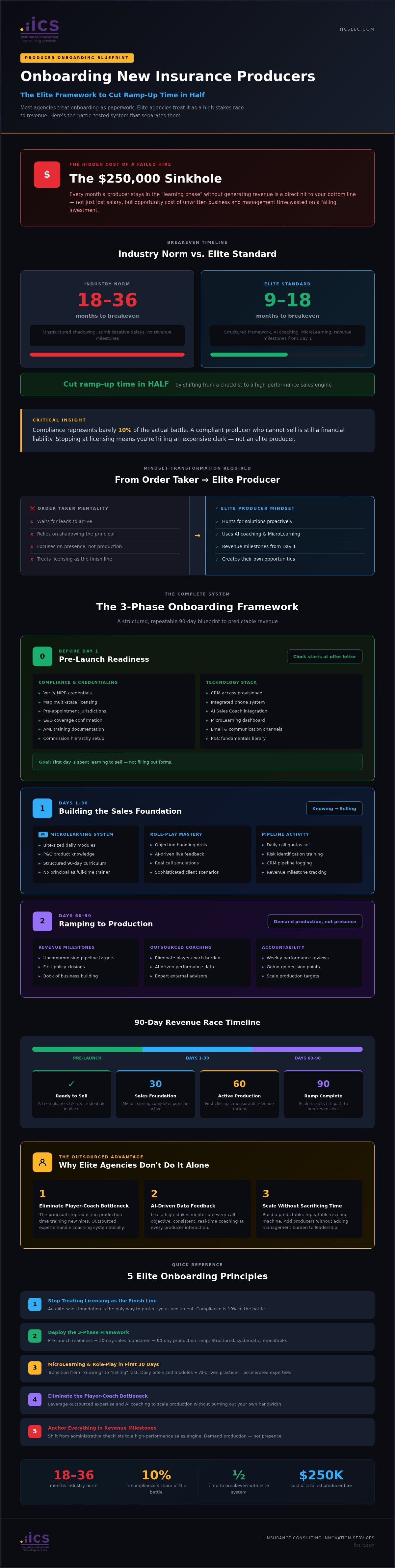
Most agency owners treat onboarding as a checklist of administrative hurdles. They focus on NIPR credentials, carrier appointments, and desk setups. This is a fatal mistake. While compliance is necessary, it represents barely 10% of the actual battle. If your process for onboarding new insurance producers stops at licensing, you aren't building a producer; you're hiring an expensive clerk. A compliant producer who cannot sell is still a financial liability.
The financial stakes are astronomical. Every month a producer remains in the "learning phase" without generating revenue is a direct hit to your bottom line. This isn't just about a lost salary. It's about the opportunity cost of unwritten business and the management time wasted on a failing investment. We call this The $250,000 Sinkhole. To avoid it, you must pivot from an "Order Taker" mentality to an "Elite Producer" mindset. Elite producers don't wait for leads to fall into their laps. they hunt for solutions and create their own opportunities.
The Reality of the 2026 Insurance Market
The days of "shadowing" the principal are over. In a 2026 market defined by hybrid work and rapid digital shifts, sitting in a corner watching a veteran work is a recipe for stagnation. It's slow. It's unstructured. It's inefficient. New hires need to acquire technical knowledge at a pace that matches the speed of the market. Success is no longer about how long someone has been in the business; it's about how quickly they can demonstrate expertise to a sophisticated client base. If your training model relies on proximity rather than a systematic framework, you're already behind.
The Breakeven Objective
Your onboarding new insurance producers system must be anchored in revenue, not just activity. The industry norm for a producer to reach breakeven often stretches between 18 to 36 months. That's unacceptable for an agency looking to scale. The elite standard is to cut that time in half. This requires setting uncompromising expectations for pipeline growth from Day 1. Are they making the calls? Are they identifying the right risks? If you aren't measuring revenue milestones from the start, you're just subsidizing a hobby. You need a process that demands production, not just presence.
Phase 1: The Pre-Launch Readiness Checklist
The clock starts ticking the moment you sign the offer letter. If you wait until Day 1 to handle paperwork, you've already lost a week of production. Onboarding new insurance producers begins long before they walk through the door. This pre-launch phase is about clearing the path so that their first day is spent learning to sell, not filling out forms. Failure here creates a friction-filled environment that kills momentum before it starts.
Compliance and Credentialing
Verification of NIPR credentials is the bare minimum. You must map out multi-state licensing requirements based on your agency's footprint. Do you know which states are "Pre-Appointment" jurisdictions? In these areas, a producer is legally barred from discussing coverage until the carrier appointment is fully processed. Don't let a regulatory technicality sideline your new hire for weeks. You must also initiate product authorizations and confirm active E&O coverage immediately. Documenting Anti-Money Laundering (AML) training completion is another critical hurdle. If these pieces aren't in place, the producer cannot contribute to the bottom line. Finally, establish their position in the agency’s commission hierarchy to ensure transparency and motivation from the start.
The Technology Onboarding
Elite production requires more than just a laptop and an email address. You need to standardize the tech stack to minimize administrative drag. Provisioning the right Effectiveness Tools ensures your new hire focuses on high-value activities rather than manual data entry. This setup includes CRM access, integrated phone systems, and, most importantly, your AI coaching platform.
Integrating the AI Sales Coach with the producer’s communication channels allows for immediate, data-driven feedback. It's like having a high-stakes mentor looking over their shoulder during every interaction. You should also configure the MicroLearning dashboard for their first 90 days. This provides a structured, repeatable training system that covers Property and Casualty fundamentals without requiring the principal to act as a full-time trainer. When onboarding new insurance producers, the goal is a seamless transition into the sales foundation. If the technology isn't ready, the producer won't be either.
Phase 2: The First 30 Days – Building the Sales Foundation
The first month of onboarding new insurance producers determines whether they become a profit center or a tax write-off. Most agencies waste this window on "culture" and "meeting the team." While rapport matters, it doesn't generate premium. You must pivot immediately to high-performance skill acquisition. This phase isn't about generalities; it's about building a lethal sales foundation through disciplined activity and precision training.
MicroLearning vs. Information Overload
Forget the week-long "bootcamp" that leaves hires drowning in a sea of policy forms. It's an outdated model that ignores how humans actually learn. Instead, implement 10-minute daily MicroLearning modules. These bite-sized sessions focus on high-impact Commercial P&C niches early on, allowing for immediate application. You aren't testing for completion; you're testing for retention. If they can't explain a specific coverage nuance after the module, they haven't learned it. This Property and Casualty Insurance Sales Training methodology ensures they stay sharp without the burnout associated with traditional training marathons.
The Art of the Discovery Call
Knowing the product is 10% of the game. Selling the solution is the other 90%. Your producers must move from "knowing" to "doing" through rigorous role-play mastery. The 2026 buyer is sophisticated and short on time. They don't want a lecture; they want a discovery process that identifies risk gaps they didn't know existed. Use AI coaching to analyze every nuance of their early outreach. Is their tone too passive? Is their pace too fast? Are they stumbling over basic objections? By recording and reviewing the first 50 live dials, you turn every failure into a data point for improvement. Stop guessing and start measuring.
Finally, establish the "Daily 10." These are non-negotiable minimum activity metrics for prospecting. It's simple. If they aren't hitting the numbers, they aren't building a pipeline. Onboarding new insurance producers requires a culture of accountability from Day 1. If you don't demand activity now, you'll never get production later. This isn't just about making calls; it's about mastering the mechanics of the hunt.
Phase 3: Days 60-90 – Ramping to Production
By day 60, the theoretical phase of onboarding new insurance producers must end. This is "Go" time. If your producer is still hiding behind role-plays and product manuals, you're losing money every hour. The transition to live prospects must be absolute. You aren't just looking for activity now; you're looking for qualified opportunities. A "lead" is simply a name on a screen. A qualified opportunity is a business owner who has admitted a risk gap and agreed to a formal review. This distinction separates the elite from the mediocre.
The Power of 1-on-1 Mentoring
Elite agencies don't leave success to chance. They review "the tape." This means performing deep dives into actual sales conversations recorded by your AI tools. Where did the conversation stall? Did the producer miss a critical cue about a complex commercial risk? We leverage a 40-year track record of sales leadership to identify the "closing gap" that prevents most new hires from crossing the finish line. If you aren't listening to the calls, you're coaching in the dark. You can't fix what you can't hear. Real-time feedback during this window is the difference between a producer who plateaus and one who scales.
Data-Driven Performance Metrics
Stop relying on gut feelings. You need hard data to determine if your investment is paying off. Analyze the "App-to-Bind" ratio for every new hire. If they're submitting dozens of applications but binding zero, they have a closing problem. If they aren't submitting at all, they have a prospecting problem. Adjust their activity targets based on skill gaps identified by your AI coaching platform. Precision is the goal here, not just volume.
You must balance "Leading Indicators" like dials and discovery meetings with "Lagging Indicators" like bound premium. By the 90-day mark, the "Breakeven" check-in is non-negotiable. Is the producer on a trajectory to hit their 6-month revenue goal? If the pipeline is empty now, it will be empty then. This is the moment to double down on advanced objection handling for sophisticated buyers. If you need a more aggressive approach to scaling your team, explore our 1:1 Call Coaching and Sales Academy programs.
Don't wait for a 12-month review to realize a hire isn't working. Onboarding new insurance producers is a race against time. Use the data, review the conversations, and demand production. The standard isn't participation. The standard is revenue.
The Outsourced Advantage: Why Elite Agencies Don't Do It Alone
The "Player-Coach" principal is a myth that kills growth. You are likely the most effective producer in your agency. Every hour you spend teaching a new hire the difference between an occurrence and a claims-made policy is an hour you aren't closing high-value accounts. Onboarding new insurance producers is a full-time job. If you try to squeeze it into the margins of your day, you will fail both the producer and your agency. Elite agencies recognize that their time is better spent on high-level strategy, while the heavy lifting of development is outsourced to experts who live and breathe performance.
The IICS Sales Academy Framework
Our 3-month Sales Academy for property and casualty producers isn't a suggestion; it's a battle-tested engine for excellence. We don't just provide information. We provide transformation. By combining AI Sales Coaching with precision MicroLearning and 1:1 Call Coaching, we double the likelihood of a new hire reaching their full potential. This isn't an expense. It's a high-ROI investment that protects your most valuable asset: your time. While the industry often accepts a 36-month breakeven, our methodology is designed to hit that milestone in half the time. You get a producer who is ready to hunt, while you stay focused on the big picture. We bring a 40-year track record of growth to your doorstep, ensuring your new hires have the technical and sales mastery required for the 2026 market.
Fractional Leadership for Agency Growth
Many agencies suffer from a leadership gap. You have producers, but you don't have a sales team. A sales team requires a culture of relentless performance and systematic accountability. This is where our Fractional CRO and CGO services become your competitive advantage. We don't just offer advice. We install the framework. We close the gap between simply having a staff and operating a predictable revenue machine. This leadership installs a permanent culture of performance that survives long after the initial training phase ends.
Taking the first step toward a battle-tested framework for success means admitting you can't do it all. You shouldn't have to. You deserve a system that identifies and develops elite talent without requiring your constant intervention. It's time to stop gambling on "shadowing" and start investing in a proven path to victory. Scale your agency with the IICS Sales Academy and turn your onboarding new insurance producers process from an administrative chore into a high-performance sales engine.
Stop Gambling and Start Scaling
Most agencies fail because they mistake administrative activity for sales progress. They wait 18 months to see if a hire sticks while their capital drains away. Success in 2026 demands a systematic approach that prioritizes revenue from the first hour. By shifting your focus from basic compliance to a high-performance sales engine, you eliminate the guesswork that plagues traditional growth models. Why leave your agency's future to chance when you can install a battle-tested framework instead?
We've detailed the necessity of pre-launch readiness and the power of microlearning to build a lethal sales foundation. You now have the blueprint to move beyond "shadowing" and into data-driven production. With our 40-year track record of industry growth, we've perfected the framework that achieves breakeven in half the industry norm time. Don't let the management burden of onboarding new insurance producers stall your momentum. It's time to leverage AI-driven coaching and expert mentoring to secure your agency's future.
Double your producer's success rate with the IICS Sales Academy. You have the tools and the strategy. Now, take the lead and build the elite production machine your agency deserves.
Frequently Asked Questions
How long should it take to onboard a new insurance producer?
While the industry norm for reaching breakeven revenue often stretches to 18 or 36 months, an elite framework should aim to cut that time in half. The intensive phase of onboarding new insurance producers typically lasts 90 days. This window focuses on moving from basic licensing to active pipeline generation. By the end of this period, a producer must be fully integrated into your sales technology and consistently hitting activity targets.
What are the most common onboarding mistakes in an insurance agency?
The most fatal error is treating onboarding as a compliance exercise rather than a sales launch. Agencies often focus exclusively on licensing and carrier appointments while ignoring sales competency. Another mistake is relying on "shadowing" as a primary training method. Shadowing is unstructured and inefficient. It fails to provide the repeatable, data-driven feedback that new hires need to master complex commercial risks and objection handling.
Do I need a dedicated sales manager to onboard new producers?
You don't need a full-time hire, but you do need dedicated leadership. Most principals are "Player-Coaches" who lack the time to provide the daily coaching required for success. This creates a bottleneck that stalls producer development. Many elite agencies solve this by using outsourced development programs or fractional CRO services. These solutions provide the high-level accountability and expert mentoring your producers crave without the executive overhead.
What is the difference between training and onboarding for insurance agents?
Training is the transfer of technical knowledge, while onboarding is the integration of that knowledge into your agency’s revenue engine. Training teaches a producer what a policy covers. Onboarding new insurance producers ensures they know how to identify a prospect, execute a discovery call, and navigate your specific tech stack. Training provides the tools; onboarding provides the battle-tested framework to use them effectively in the field.
How much does it cost to ramp up a new commercial P&C producer?
The real cost is far higher than a simple salary figure. You must account for benefits, taxes, and the staggering opportunity cost of unwritten business. This is why we refer to the "sinkhole" of a non-producing hire. Every month a producer fails to generate revenue, your agency’s capital investment disappears. Reducing the ramp-up time through a structured system is the only way to protect your bottom line from this drain.
Can AI really help in the producer onboarding process?
AI is a force multiplier for sales performance. It provides objective, data-driven feedback on actual sales conversations by analyzing tone, pace, and objection handling. Instead of a principal guessing why a deal stalled, AI identifies the exact moment a producer lost the prospect. This allows for surgical coaching that fixes skill gaps in real-time. It turns every sales call into a high-stakes learning opportunity that accelerates the path to revenue.
What metrics should I track during the first 90 days of a new hire?
Focus on leading indicators during the first 60 days. Track daily dials, discovery meetings scheduled, and qualified opportunities added to the pipeline. These metrics prove the producer is doing the work. As you approach the 90-day mark, shift your focus to lagging indicators like the "App-to-Bind" ratio and bound premium. If the activity is high but the production is low, you have a closing problem that requires immediate intervention.
Why is the first 90 days critical for producer retention?
The first 90 days establish the standard for professional discipline. If a producer doesn't see a clear path to revenue or feels unsupported by a structured system, they will likely churn before they ever become profitable. Early wins are the best predictor of long-term success. A producer who masters the mechanics of the hunt and starts writing business quickly is a producer who will stay and scale with your agency.