The Habits of Successful Insurance Producers: A 2026 Blueprint for Elite Performance
Updated: 4 days ago
Why do most producers treat their schedule like a suggestion while the elite treat it like a blueprint for wealth? In a 2026 environment where commercial property premiums fell 5.5 percent in the first quarter, the era of accidental success is officially over. If you feel like you're drowning in administrative tasks that pay nothing while your pipeline fluctuates between feast and famine, you've hit a ceiling that effort alone cannot break. The habits of successful insurance producers are built on high-precision micro-habits, not just a vague commitment to grinding harder.
It's frustrating to lack technical confidence when facing sophisticated commercial clients who expect more than just a quote. You deserve a system that works as hard as you do. This blueprint reveals the battle-tested daily routines and tactical systems required to achieve breakeven revenue in half the industry norm time. We will analyze the 90-day sales framework that doubles your likelihood of becoming a top producer; this ensures your performance remains elite regardless of market shifts. It is time to stop guessing and start executing a proven methodology for growth.
Table of Contents
Activity vs. Results: The Myth of the "Busy" Insurance Producer
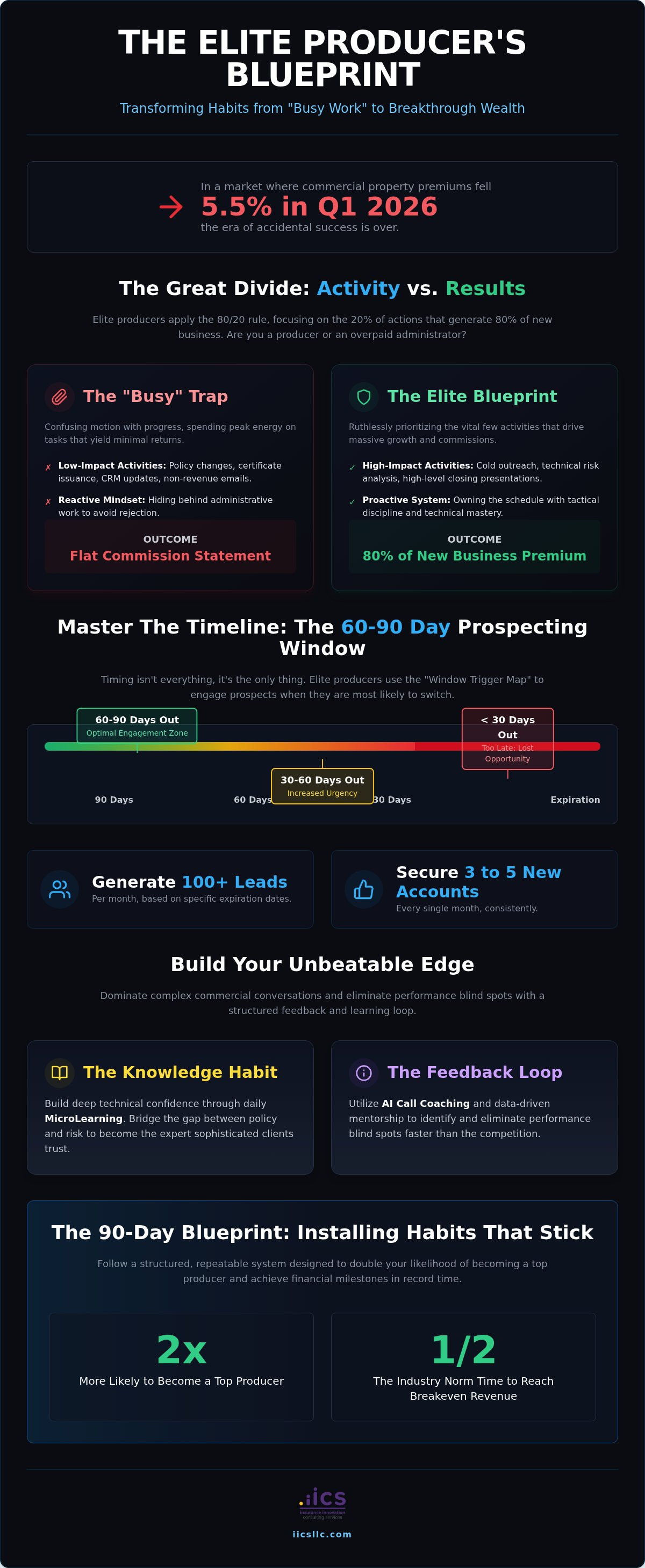
Many Independent insurance agents confuse motion with progress. They spend eight hours a day shuffling paper, updating CRM notes, and responding to non-revenue-generating emails. This is the "Busy Trap." It feels productive, but it results in a flat commission statement at the end of the quarter. The habits of successful insurance producers are rooted in the Pareto Principle: 20% of your daily actions generate 80% of your new business premium. If you aren't spending the majority of your time in that 20% bracket, you aren't a producer; you're an overpaid administrator. Most producers hide behind administrative tasks because they're easier than the rejection of a cold call or the complexity of a technical risk assessment.
High-impact activities include cold outreach, technical risk analysis, and high-level closing presentations. Low-impact activities are policy changes, certificate issuance, and "cleaning up" files. If you're spending your peak energy hours on tasks that an account manager should handle, you're effectively stealing from your own future commissions. At IICS, we believe that if a producer is worth hiring, they're worth developing the right way. That development starts with a ruthless audit of how you spend your minutes. Do you own your schedule, or does your inbox own you?
The High-Performance Mindset
Elite P&C specialists don't wait for the phone to ring. That's a terminal habit for anyone entering the 2026 market. Transitioning from a generalist who takes whatever comes over the transom to a specialist who targets high-value commercial niches requires a shift in accountability. You aren't just competing against the guy in the next cubicle. You're competing against a national landscape of data-driven sharks who use precision systems to identify your best clients before you even send a renewal notice. Success requires an uncompromising standard of performance that most simply aren't willing to meet.
Setting the Baseline for 2026
The current industry norm for reaching breakeven revenue is sluggish and outdated. Many agencies accept a two to three year window for a new producer to "find their feet." In an environment where overall commercial premium growth was flat at just +0.2% in the first half of 2026, you can't afford to wait. Elite performers target breakeven in half the industry norm time by installing a repeatable 90-day system. Elite production is a combination of tactical discipline and technical mastery. It's about knowing the risk better than the carrier does and out-working the competition in the prospecting trenches every single day.
The Prospecting Habit: Mastering the 60-90 Day Renewal Window
If you wait until 30 days before a policy expires to make your move, you've already lost. The incumbent agent has likely already sent the renewal, and the client is mentally committed to the path of least resistance. One of the most critical habits of successful insurance producers is the mastery of the 60-90 day renewal window. This is the "Window Trigger Map." It is the precise period where a business owner begins to feel the friction of premium increases but hasn't yet resigned themselves to the status quo. To dominate this space, you must commit to generating at least 100 leads per month based on specific expiration dates. This volume is the fuel required to consistently secure 3 to 5 new accounts every month. Data from the U.S. Bureau of Labor Statistics highlights that the field is intensely competitive; therefore, those who lack a disciplined prospecting system will inevitably be outpaced by those who treat timing as a science. To further enhance your prospecting through strategic referrals, you might check out BNI Czechia and their professional networking groups.
When a prospect says they're "happy with their current agent," do you fold or do you pivot? A disciplined producer has a scripted response ready that challenges whether that agent has provided a comprehensive risk audit in the last 12 months. Winning through basics means committing to three non-negotiable habits every week: ten new calls, five follow-ups, and one technical deep-dive. This consistency separates the elite from the "feast or famine" crowd. In 2026, virtual meetings are the standard, but they require more disciplined agenda framing than in-person sit-downs. If you don't control the narrative in the first three minutes, you lose the room. To see how these routines are installed in real-world scenarios, you can look inside the academy to see our tactical framework in action.
The Knowledge Habit: Bridging the Gap Between Policy and Risk
Technical mastery is the ultimate confidence builder in commercial sales. While average agents rely on a "likable" personality, elite producers rely on a deep understanding of policy language. If you don't know the difference between an ISO standard form and a custom manuscript endorsement, you're merely a quote-taker waiting to be replaced by an algorithm. One of the primary habits of successful insurance producers is the commitment to daily MicroLearning. Instead of drowning in a six-hour "firehose" training session once a quarter, spend three minutes every morning dissecting a specific endorsement or carrier appetite shift. This builds a cumulative advantage that makes you the most dangerous person in the room. The habits of successful insurance producers aren't just about sales scripts; they're about knowing the contract better than the person who signed it.
You must speak with authority regarding products, limits, and exclusions. Can you explain why a "Classification Limitation" on a General Liability policy could bankrupt your prospect? If not, you aren't selling protection; you're selling a piece of paper. Technical knowledge allows you to challenge the incumbent agent's work with surgical precision. It turns a standard sales call into a high-stakes consultation where the client realizes they can't afford to stay with their current agent.
Risk and Coverage Deep Dives
SME commercial accounts require a different lens than enterprise risks. For instance, shifting state and municipal laws regarding worker classification can create massive liabilities in workers' compensation. If you aren't tracking these nuances, you're leaving your clients exposed. Elite producers translate these technical threats into plain-language loss examples. They don't use jargon to confuse; they use it to illuminate the specific financial risks the client hasn't considered. This transition from salesperson to risk advisor is what separates the top 1% from the rest of the pack.
The "Z‑Pattern" of Policy Review
Top-tier producers develop the habit of the "Z-Pattern." This is a systematic method for scanning a declaration page and schedule of forms to spot coverage gaps in ten minutes or less. You should never walk into a first meeting without identifying at least three specific deficiencies in the current program. By using AI-assisted industry insights, you can arrive prepared with data on recent litigation trends specific to the prospect's industry. This level of preparation is a cornerstone of Advanced Commercial Insurance Sales Techniques. This habit ensures you aren't just another salesperson asking for a chance to quote. You are a risk professional pointing out a fire in their foundation that they didn't know was burning.
The Feedback Loop: Using AI and Mentorship to Eliminate Blind Spots
Most producers operate on a "gut feeling" after a sales call. They think it went well because the prospect was polite. Elite producers know that politeness doesn't pay commissions. The habits of successful insurance producers in 2026 involve a shift to data-driven performance analysis. By September 2026, AI adoption in agencies has surged to 64 percent. If you aren't using these tools to score your interactions, you're flying blind. AI call coaching provides a cold, objective look at your performance. It scores every interaction against elite criteria, identifying exactly where you lost control of the narrative or missed a critical coverage trigger. This level of precision is no longer optional. It's the standard for those who refuse to settle for average.
Reviewing call recordings is not an exercise in vanity. It is a tactical debrief. High-performers listen for pacing, tonality, and missed objections. While AI provides the data, 1:1 mentoring with seasoned veterans remains the "secret sauce" of the top 1 percent. A mentor who has survived forty years of market cycles can spot the subtle nuances an algorithm might miss. This combination of high-tech feedback and high-touch wisdom is what accelerates a producer toward the top tier. You don't need more leads; you need fewer mistakes. Mastery requires an uncompromising look at your own failures.
Leveraging AI Sales Coaching
AI identifies missed opportunities in real-time. It acts as a digital ride-along that never gets tired or distracted. This discipline of constant refinement allows you to perfect your scripts and pacing before you ever step into a high-stakes commercial meeting. It analyzes your talk-to-listen ratio and flags when you've failed to ask a probing question about a client's risk profile. For those looking to gain a competitive edge, implementing AI Sales Coaching for Insurance is the fastest way to accelerate your development and eliminate performance blind spots.
The Role of Peer Learning and Workshops
Why do elite producers never stop practicing their "First Call Basics"? Because they understand that mastery is a pursuit, not a destination. Weekly live workshops provide the necessary accountability and a safe environment for scenario role-play. Being part of an "Elite Producer" peer group creates a psychological shift. You stop comparing yourself to the average and start measuring yourself against the best in the country. This environment demands excellence and refuses to tolerate stagnation. It forces you to defend your strategies and sharpen your technical arguments. If you are ready to stop guessing and start growing, join the Sales Academy for property and casualty Insurance Producers today.
The 90-Day Blueprint: Installing Habits That Stick
Transformation doesn't happen by accident. It happens through a structured, high-stakes timeline that replaces amateur tendencies with the habits of successful insurance producers. Most training programs fail because they offer information without implementation. Our 90-day blueprint is different. It is a tactical march toward elite performance, divided into three distinct phases of growth. We operate with a "No Hidden Fees" philosophy; you get the full framework for success without the typical industry fluff or bait-and-switch tactics. This transparency ensures you can focus entirely on the execution of the system rather than wondering what the catch is.
Month 1 focuses on foundations and core skills. This is where you set the "Suspect List" habit. You'll learn to identify high-value targets and build a list that isn't just a collection of names, but a map to future commissions. Month 2 shifts to pipeline development. You will master the 60-day renewal window, ensuring you engage prospects exactly when they are most vulnerable to a change. By Month 3, you move into advanced selling scenarios and personal brand building. You'll learn to position yourself as an indispensable risk advisor, not just another insurance agent with a quote sheet. This progression is designed to build momentum that lasts long after the 90 days are over.
Daily Tactical Micro-Learning
Traditional training is a firehose that leads to cognitive overload. We use 2-4 minute video lessons designed for the busy professional who needs immediate, actionable insights. By committing to 60 tactical modules over three months, you build a compound interest of knowledge. It's about precision, not volume. For those ready to commit, use the code Summer2026 to access this elite training at a 50 percent discount. This reduces the retail tuition from $3,000 per month to just $1,500 per month. This is an investment that pays for itself with your first major commercial win. Stop wasting time on generic seminars and start learning the tactics that actually move the needle.
From Good to Elite: The IICS Path
The numbers don't lie. Graduates of our program double their likelihood of becoming top producers. This isn't a theory; it's a result of the 40-year track record behind the IICS Sales Academy and the leadership of Ralph Blust. We have spent four decades refining the habits of successful insurance producers across the country. We know what works, and more importantly, we know why the average producer fails. If you are tired of inconsistent cycles and administrative busy work, it is time to take the next step. Explore the Sales Academy Curriculum and begin your 90-day transformation today.
Master the Blueprint for Elite Production
The gap between a struggling producer and a top-tier professional isn't talent; it is the execution of high-precision systems. You've seen how the 80/20 rule separates activity from results and why mastering the 60-90 day renewal window is non-negotiable. The habits of successful insurance producers are forged through technical mastery and data-driven feedback. If you continue to rely on gut feelings while your competitors use AI to score every interaction, you are choosing stagnation. Statistics show that agents with formal training achieve 52 percent higher sales than their peers. Why leave your commission to chance?
IICS brings a 40-year track record of growth and development to your desk, including unlimited AI-driven call coaching to eliminate your blind spots. You can choose to stay in the "feast or famine" cycle, or you can install a repeatable 90-day sales system that works. It's time to demand more from your career. Join the Sales Academy and Double Your Likelihood of Success. The path to elite performance is open; you just have to take the first step toward your future.
Frequently Asked Questions
What are the most important daily habits for a new insurance producer?
The most important habits of successful insurance producers include a ruthless focus on high-impact prospecting. You should pull ten new names from state filings every Monday morning to ensure your pipeline never runs dry. Spend your peak energy hours on cold outreach and technical risk analysis instead of administrative tasks. If you aren't spending at least 20 percent of your day on revenue-generating actions, you're effectively an overpaid administrator.
How long does it take for a new P&C producer to become profitable?
The industry standard for reaching breakeven is often two to three years; however, that is a failing benchmark for elite agencies. Top-tier producers aim to reach profitability in half the industry norm time. By installing a repeatable 90-day system, you can accelerate your path to revenue. This speed is achieved by focusing on high-probability suspects and mastering the 60-day renewal window from the very first month of your career.
Is formal sales training necessary for experienced insurance agents?
Experience doesn't always equal excellence. Agents who undergo formal training achieve 52 percent higher sales and a 53 percent increase in lead-to-prospect conversion. Even seasoned veterans find that their "First Call Basics" can become sloppy over time. A structured environment provides the accountability and technical deep-dives needed to stay ahead of the national competition. It's about maintaining an elite standard regardless of how long you've been in the game.
How can AI help insurance producers close more commercial accounts?
AI provides an objective, data-driven look at your sales performance that a "gut feeling" simply cannot match. It scores every interaction against nine elite criteria, identifying exactly where you lost control or missed a coverage trigger. This allows you to refine your pacing and scripts before stepping into high-stakes commercial meetings. By using these insights, you can close more accounts by addressing technical risks that your competitors completely overlook.
What is the "buying window" in commercial P&C insurance?
In commercial P&C, the actual buying window typically opens 30 to 60 days before a policy expires. However, successful outreach must begin 60 to 90 days before expiration to be effective. This early start allows you to position yourself as a risk advisor before the incumbent agent sends a renewal notice. If you wait until the 30-day mark, you're fighting an uphill battle against the prospect's desire for the path of least resistance.
Why do most insurance producer training programs fail to deliver results?
Most programs fail because they use a "firehose" approach that causes cognitive overload. They provide information but lack the tactical implementation needed to build the habits of successful insurance producers. Without real-time feedback loops like AI call coaching or 1:1 mentorship with veterans, information is rarely retained. A successful program requires a structured 90-day blueprint that focuses on micro-learning and daily discipline rather than generic sales theories or outdated seminars.
How much does the IICS Sales Academy cost in 2026?
The retail tuition for the IICS Sales Academy is $3,000 per month for the three-month program. However, invited agencies can access a significant discount. By using the code "Summer2026," the cost is reduced by 50 percent to $1,500 per month per student. This price includes full access to 60 tactical modules, unlimited AI call coaching, and weekly live workshops. There are no hidden fees or upsells throughout the duration of the academy.
Can insurance sales habits be learned through micro-learning?
Micro-learning is the most effective way to install new skills without disrupting your production schedule. Daily tactical video lessons lasting only two to four minutes prevent the burnout associated with traditional training. This method allows you to absorb 60 modules over a 90-day period, ensuring that each lesson is small enough to be implemented immediately. It transforms learning from a rare event into a daily discipline that drives long-term sales growth.