The Real Cost of a Non-Producing Insurance Hire in 2026
Updated: 5 days ago
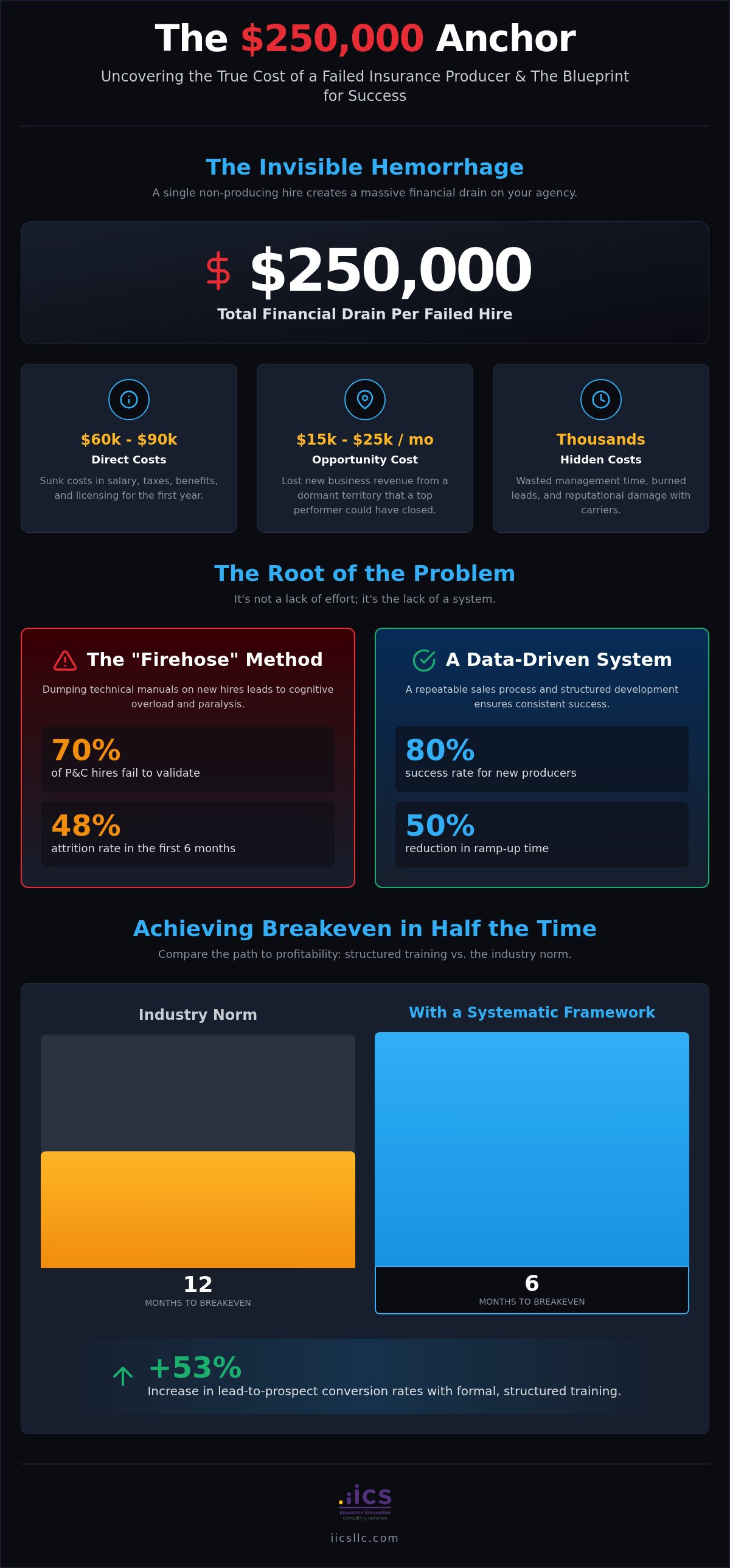
How much is that silent producer in the corner office actually costing your agency? It's not just the base salary or the licensing fees. It is a $250,000 anchor dragging down your firm's growth while your best managers burn out on hand-holding that never leads to a closed deal. Most agency owners struggle when calculating ROI on insurance producer training because they overlook the massive opportunity cost of lost territories and the 48% attrition rate that plagues the first six months of employment.
You've likely felt the sting of a high-potential hire who fails to validate after a year of investment. It's an expensive cycle that stops today. We will uncover the precise financial drain of these failed hires and give you the 90-day framework required to achieve breakeven revenue in half the industry norm time. You're about to learn how to reduce ramp-up time by 50% and implement a systematic development process that yields an 80% success rate for every new producer you bring into the fold.
Table of Contents
The Invisible Hemorrhage: Quantifying the True Cost of a Failed Producer
A non-producing producer is a parasite on your agency's growth. It is a harsh reality; it is also a mathematically undeniable one. You cannot afford to treat hiring as a "wait and see" game because the gap between a producer's salary and their actual output represents a direct threat to your agency's valuation. When you define a non-producing hire, you're looking at the chasm between their draw and their actual premium generation. The direct losses are the easiest to track. Salary, taxes, and benefits usually total between $60,000 and $90,000 in the first year alone. However, high employee turnover in the insurance sector suggests that the real damage lies beneath the surface. You're losing more than just a paycheck; you're losing the confidence of your carriers and the morale of your support staff who are tired of processing "practice" applications that never bind.
Think about your prime territories. Every month a non-producer sits in that seat, a top performer could have been generating $15,000 to $25,000 in new business revenue. That's money gone forever. Carriers notice when a territory goes cold. Your reputation with underwriters takes a hit when you send them low-quality, unclosed submissions. This reputational damage makes it harder for your successful producers to get the favorable terms they need to win, which is why many agencies consult a corporate private investigator NYC to vet high-stakes hires before they impact the bottom line.
The $250,000 Ceiling: A Breakdown of Hidden Losses
The ROI of Getting it Right the First Time
Beyond vetting, streamlining the entire recruitment process with AI-driven solutions from BlueBridge Group Placement Corp allows agencies to identify high-potential producers who are most likely to thrive in a structured training environment.
Success changes the math instantly. Agents who receive formal, structured training see a 53% increase in their lead-to-prospect conversion rates compared to those left to figure it out on their own. When you hit breakeven in six months instead of the 12-month industry norm, you're not just saving salary; you're accelerating agency profit. By accurately calculating ROI on insurance producer training, you can justify the investment in elite development programs that ensure a high-stakes hire becomes a high-performing asset. The Cost of Failure is the total financial loss of a failed hire expressed as a percentage of your annual agency revenue.
Why 70% of P&C Hires Fail (And It Is Not Their Work Ethic)
Most agencies hire for "hustle" and then wonder why their new producers flame out within twelve months. It isn't a lack of effort. It's the Firehose Problem. You dump years of technical manuals and carrier guidelines onto a new hire's desk and expect them to swim. This cognitive overload paralyzes talent. Without a repeatable sales process, "just go sell" isn't a strategy; it's a recipe for disaster. Producers end up guessing. They target accounts outside their "strike zone" because they don't understand carrier appetite, leading to a pile of unbindable submissions and wasted underwriter goodwill.
Technical ignorance is the silent killer of credibility. If a producer cannot distinguish between a standard ISO form, like the CG 00 01, and a restrictive custom endorsement, they aren't a risk advisor. They're a price-quoter. This lack of expertise directly inflates the total cost of employee turnover because you're paying a professional salary for someone who cannot provide professional value. When you are calculating ROI on insurance producer training, you must factor in the massive cost of these technical blind spots.
Incumbent Displacement vs. General Selling
Commercial P&C isn't about finding someone who needs insurance. It's about displacing an incumbent agent. Most generic sales training fails because it doesn't prepare producers for the "I'm happy with my agent" wall. Success requires a deep understanding of how state, county, and municipal laws impact risk. If your producer doesn't know the specific legal pressures facing a contractor or a manufacturer, they can't create the doubt necessary to win the business. Confidence comes from knowing the carrier's appetite before the first call is even made.
The Accountability Void
Quarterly boot camps are where information goes to die. Real retention happens in weekly, tactical sessions. Most agency principals coach based on "gut feelings," which is subjective, inconsistent, and often wrong. This creates an accountability void. AI Sales Coaching solves this by providing data-driven, real-time feedback on actual calls, removing the subjectivity from performance reviews. This level of precision is critical when calculating ROI on insurance producer training because it turns "hope" into a measurable metric. Agencies looking to bridge this gap often find that a structured sales academy provides the consistent rhythm necessary to turn a new hire into an elite producer.
The First 90 Days: A Blueprint for Elite Producer Development
The first 90 days of a new hire's tenure are not a trial period; they're a battle for survival. If you wait twelve months to decide if a producer is "working," you've already lost the game and the capital. When you're calculating ROI on insurance producer training, you must measure the speed of habit formation, not just premium bound. This 90-day blueprint is designed to build an elite producer through tactical trimesters that emphasize action over theory. By integrating daily micro-learning sessions, such as three-minute tactical modules, you ensure that complex sales skills are digested and applied rather than forgotten. This systematic approach transforms the "firehose" into a steady stream of development.
The progression is deliberate. Days 1-30 focus on foundations and core sales skills. Days 31-60 move into aggressive pipeline development and the execution of the first call. Finally, Days 61-90 tackle advanced scenarios and client management. This structure ensures your hire is never left wondering what to do next. It eliminates the "just go sell" ambiguity that kills 70% of P&C hires.
Trimester One: Mastering the P&C Foundations
Success in the first thirty days is about mapping the terrain. Producers must identify and map five distinct social circles and define specific networking actions for each (Topic 32). This isn't about general socializing; it's about building a Suspect List categorized by effective date to ensure a full pipeline six months down the road. Elite producers master the 30-60 day renewal buying window early. They understand that if they aren't in the conversation sixty days before expiration, they aren't competing; they're just spectating. This level of discipline is a primary factor when calculating ROI on insurance producer training because it creates predictable future revenue.
Trimester Two: The Art of the Displacement
By day 60, the producer must move from listing suspects to displacing incumbents. This requires scripting precise responses to the "Happy with my agent" objection (Topic 35) to create the necessary doubt to win an appointment. We leverage AI-assisted industry insights to project risk expertise (Topic 36), allowing a new producer to speak with the authority of a twenty-year veteran. They learn to identify gaps in coverage that the current agent has ignored, positioning themselves as the superior risk advisor. To master these high-level maneuvers, producers should study Advanced Commercial Insurance Sales Techniques to refine their displacement strategy. This is where the investment in training begins to pay dividends, as the producer starts to secure the meetings that lead to significant commission growth.
Implementing a Data-Driven Sales Development System
Gut instinct is for gamblers. Agency growth is for mathematicians. If you're still evaluating producers based on how "busy" they look or the tone of their voice in the breakroom, you're flying blind. Calculating ROI on insurance producer training requires a transition from instinct to hard metrics. Every agency principal must track specific leading indicators through a 9-criteria scoring system that measures actual development. This system doesn't just look at the bottom line; it evaluates the tactical execution of the sales process, ensuring that growth is sustainable and not just a streak of luck. While generic outsourced coaching offers platitudes, 1:1 mentoring with a 40-year veteran provides the battle-tested wisdom needed to navigate complex commercial risks.
AI Coaching: The Scalability Secret
Management burnout often stems from the "fire drill" culture of manual call reviews. You can't listen to every recording, and you shouldn't have to. Leveraging AI Sales Coaching for Insurance provides unlimited, real-time feedback and scoring for every interaction. The AI identifies next-step guidance during live calls, acting as a digital wingman for the producer. This technology automates the review process, allowing you to focus on high-level strategy while the system ensures every producer stays on script and on target. It turns the subjective "good call" into a data point you can actually use when calculating ROI on insurance producer training.
Micro-Learning: The Science of Habit Formation
Seminars are an exercise in futility. An eight-hour session creates a temporary spike in motivation followed by a 90% decay in knowledge within 30 days. In contrast, 60 tactical modules delivered as three-minute daily videos ensure that information is retained and converted into muscle memory. This micro-learning approach respects the busy schedule of a producer while building the Three Basic Habits commitment (Topic 40) required for long-term success. Short, punchy videos are more effective than eight-hour seminars because they focus on one specific, actionable tactic that the producer can implement immediately. This isn't just training; it's a systematic rewiring of your sales force for elite performance. To see this data-driven system in action, explore the Sales Academy framework and start building your high-performance team today.
The IICS Sales Academy: Achieving Breakeven in Half the Time
Generic training is the enemy of the specialized agency. Most programs offer broad sales platitudes that fail the moment a producer encounters a complex commercial risk or a sophisticated buyer. The IICS Sales Academy for property and casualty Insurance Producers is different because it was built exclusively for the Commercial P&C environment. We don't teach "sales"; we teach displacement and risk advisory. By following our structured trimesters, your new hires double their likelihood of becoming top-tier producers. They gain access to an elite resource library featuring tactical workbooks, effectiveness tools, and high-conversion sales content that would take years to develop internally. This is the precision instrument required for calculating ROI on insurance producer training and ensuring that your investment yields a high-performing asset rather than a $250,000 liability.
The financial math is transparent. While the retail tuition is $3,000 per month, invited agencies access this elite development for just $1,500 per month. Contrast that $4,500 total quarterly investment against the quarter-million-dollar hemorrhage of a failed hire. The choice isn't just about training; it's about agency survival and the protection of your most valuable territories.
What’s Included in the 90-Day System
Elite performance requires a multi-layered approach. Our system integrates daily micro-learning modules to build habits, unlimited AI coaching for real-time feedback, and weekly live workshops for tactical deep dives. Your producers won't just learn theory; they will receive monthly 1:1 coaching directly from academy founder Ralph Blust, a 40-year veteran of the industry. This level of mentorship is unprecedented in outsourced development. For a detailed look at the 60 tactical modules and our specific P&C curriculum, view the full details Inside the Academy. This comprehensive support structure is why we're able to reach breakeven in half the industry norm time.
Securing Your Agency’s Growth
Stop gambling on unproven talent. You can secure your agency’s growth today by enrolling your next hire in a battle-tested system. Use discount code Summer2026 to claim your 50% discount off retail tuition, bringing your monthly investment to $1,500. We maintain a strict "No Upsell" promise; your tuition includes full access to every effectiveness tool and resource in our library. There are no hidden fees or gated content. When you're calculating ROI on insurance producer training, the predictability of this cost makes the decision simple. It's time to move from hope to a system. Apply for the Sales Academy now and start building the elite team your agency deserves.
Stop the Financial Drain and Scale Your Elite Sales Force
Stop treating your agency's capital as a sacrificial offering to unproven talent. You've seen the data. A non-producing hire isn't just a minor setback; it's a $250,000 hemorrhage that threatens your firm's stability and carrier relationships. When you shift your focus to calculating ROI on insurance producer training, the path to elite performance becomes clear. Success isn't a matter of luck; it's the result of a battle-tested, 90-day system that replaces the firehose with tactical micro-learning and AI-driven precision.
With a 40-year track record of development, we've proven that formally trained agents achieve 52% higher sales and reach breakeven in half the industry norm time. Don't let another prime territory go cold while you wait for a producer to figure it out on your dime. It's time to implement the framework that turns new hires into top-tier assets. You've built a great agency. Now, give your team the tools to dominate the market.
Join the IICS Sales Academy and transform your producer development today. Your agency's future depends on the systems you build now. You've got the ambition; we've got the blueprint to make your team elite.
Frequently Asked Questions
What is the average failure rate for new insurance producers?
Industry data shows a high attrition rate, with nearly 48% of agent turnover occurring within the first 6 months. Many sources suggest that up to 70% of hires fail to validate or produce within their first year. This failure is rarely due to a lack of work ethic; it's usually a lack of structured development. Without a systematic approach, agencies gamble on talent rather than investing in a proven development framework.
How much does it cost an agency when a producer fails to produce?
The total financial drain often reaches $250,000 when you account for the "Invisible Hemorrhage." This includes the direct salary and benefits, typically $60,000 to $90,000, plus the opportunity cost of lost revenue in a prime territory. You must also calculate the principal's time spent on salvage missions and the reputational damage with carriers who see low-quality submissions. Every failed hire is a massive drain on agency capital.
How long does it typically take for a P&C producer to reach breakeven?
The industry norm for validation or breakeven is typically 12 to 24 months. However, a structured 90-day system like the IICS Sales Academy aims to reach this milestone in half the time. By focusing on the 30-60 day renewal buying window and aggressive pipeline development, producers can start generating significant revenue much faster than those left to learn by trial and error. Speed to revenue is the ultimate performance metric.
What are the main reasons insurance producers fail in their first year?
Most failures stem from the "Firehose Problem" where hires are overwhelmed with data but lack a repeatable sales process. Producers often target accounts outside their "strike zone" or fail to displace incumbents because they don't understand risk advisory. Technical gaps, such as being unable to distinguish between ISO and custom forms, also destroy credibility during the first call with a sophisticated commercial buyer. Without technical expertise, producers are just price-quoters.
Can AI coaching really improve insurance sales performance?
Yes, by providing unlimited, real-time feedback that eliminates the subjectivity of traditional management reviews. AI call coaching scores interactions against nine specific criteria and offers next-step guidance during live calls. This technology allows for rapid habit formation and ensures producers stay on script. It is a critical component when calculating ROI on insurance producer training because it provides measurable, data-driven performance metrics that gut feelings simply cannot match.
Is the IICS Sales Academy suitable for experienced producers or only new hires?
While the 90-day system is ideal for onboarding new talent, it is equally effective for experienced producers who have plateaued. The curriculum covers advanced displacement techniques, AI-assisted industry insights, and soft-market tactics. Even veteran agents benefit from refining their 30-60 day renewal strategy and mastering technical nuances, like ISO versus custom form wording differences, to increase their lead-to-prospect conversion rates and build a more robust book of business.
What is the difference between general sales training and P&C-specific training?
General training teaches you how to sell, but P&C-specific training teaches you how to win in a commercial environment. Generic programs ignore the complexity of state and municipal laws or carrier appetite. IICS focuses exclusively on Commercial P&C Producers, teaching them how to identify coverage gaps and handle the "happy with my agent" objection. This specialization is essential for calculating ROI on insurance producer training accurately and achieving elite results.
How do I get the 50% invited-agency discount for IICS?
Agencies can access the elite development system for $1,500 per month by using the discount code Summer2026. This 50% reduction from the retail tuition of $3,000 per month is available to invited agencies and includes full access to the Sales Academy curriculum. There are no hidden fees or upsells; the tuition covers daily micro-learning, AI coaching, weekly workshops, and monthly 1:1 mentoring sessions with veteran leadership. It is a transparent investment in growth.