The ROI of Elite Performance: A Guide to Insurance Sales Training Programs in 2026
- Jul 24
- 12 min read
Updated: Aug 3
How much capital are you willing to incinerate while waiting 18 months for a new hire to finally pay for themselves? Many agency owners view the ROI of insurance producer training through a lens of survival rather than strategic growth. They accept sluggish timelines as an unavoidable cost of doing business. It's a legacy mindset that treats talent acquisition like a high-stakes gamble rather than a precise science. You've likely felt the sting of a failed hire who drained resources for a year before walking out the door. It's a pattern that stalls momentum and rewards mediocrity.
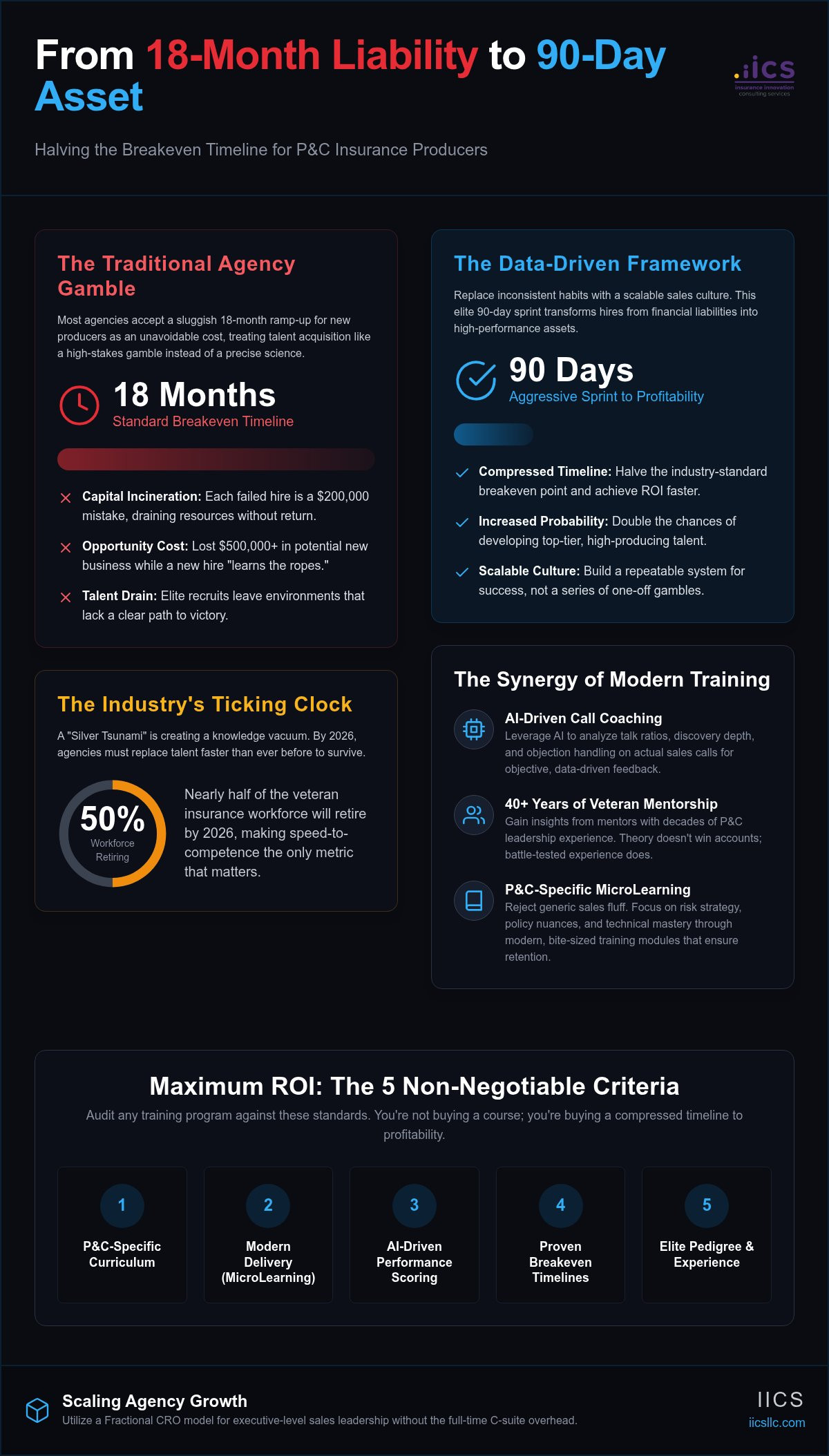
It's time to stop accepting the status quo. This guide reveals the data-driven framework used to halve the standard breakeven timeline for P&C producers. We'll show you how to replace inconsistent habits with a scalable sales culture that doubles your probability of developing top-tier talent. We'll preview the mechanics of an elite 90-day sprint, leveraging AI coaching and veteran leadership to transform your next hire from a financial liability into a high-performance asset.
Table of Contents
The Staggering Cost of Slow Producer Ramp-Up in 2026
The insurance industry is facing a quiet catastrophe. By 2026, the "Silver Tsunami" will have washed away nearly 50% of the veteran workforce. This isn't just a talent gap; it's a knowledge vacuum that threatens the very survival of traditional agencies. When half your producers are walking out the door into retirement, your ability to replace them with high-performing talent isn't a luxury. It's a requirement for survival. Speed-to-competence is now the only metric that matters in a hyper-competitive landscape.
How do you measure the ROI of insurance producer training? Most agency owners look at the price tag of a seminar or a digital course. That's a mistake. True ROI is found in the compression of time. It's the delta between an 18-month "hope and pray" ramp-up and a 90-day data-driven sprint to profitability. If your producers aren't hitting breakeven in half the industry-standard time, you aren't investing in training. You're subsidizing failure. The clock is ticking on every new hire. Every day they aren't producing is a day your agency's valuation stagnates.
The Anatomy of a Non-Producing Hire
The burn rate of a stagnant hire is staggering. It's not just the base salary or the benefits package. It's the opportunity cost of the $500,000 in new business they didn't write because they were still "learning the ropes." A "sink or swim" onboarding strategy is a $200,000 mistake that most modern agencies simply can't afford to make. Beyond the financial drain, there's a psychological toll. Elite talent doesn't stay in environments where they feel incompetent. They want to win. If your process doesn't provide a clear path to victory, your best recruits will leave for a competitor who does. Most agencies fail to identify these washouts until it's too late, often waiting a year or more to cut ties with a producer who was never destined to succeed.
P&C Commercial Lines: The Complexity Gap
Commercial P&C is not a commodity. While foundational sales principles provide a starting point, they're insufficient for the high-stakes world of risk management and complex coverage. General sales training often fails because it treats insurance like any other product. It ignores the technical mastery required to navigate middle-market accounts or specialized niches. You don't need a salesperson; you need a risk strategist. This requires a shift toward advanced commercial insurance sales techniques that prioritize precision over persistence. In the 2026 market, technical competence is the prerequisite for trust. Without it, your producers are just making noise while your competitors are closing the business.
How to Evaluate Insurance Sales Training Programs for Maximum ROI
Choosing a training program based on the lowest tuition is a fast track to mediocre results. You aren't buying a course; you're buying a compressed timeline to profitability. If a provider cannot show you exactly how they shorten the distance between a hire's start date and their first major commission check, they're selling entertainment, not performance. The ROI of insurance producer training is found in the hard data of your agency's profit and loss statement, not in a participant's "feel-good" survey at the end of a seminar.
To maximize your investment, you must audit programs against five non-negotiable criteria:
P&C-Specific Curriculum: Reject generic "sales" fluff. Your producers need to understand risk strategy and policy nuances, not just how to "close" a deal.
Modern Delivery: Ensure the training uses MicroLearning rather than exhausting, multi-day cram sessions that lead to zero retention.
AI-Driven Scoring: Demand objective data. Programs should use AI to analyze talk ratios, discovery depth, and objection handling on actual sales calls.
Proven Breakeven Timelines: Don't settle for vague testimonials. Ask for the specific number of days it takes for their graduates to reach revenue neutrality.
Elite Pedigree: Verify that the mentors have decades of actual P&C leadership experience. Theory doesn't win accounts; battle-tested experience does.
An insurance sales program case study often highlights the financial impact of structured methodology, but the 2026 market demands even more precision. You need a system that integrates into the daily workflow of a producer, providing real-time corrections before bad habits become permanent. If you're serious about shifting your agency's trajectory, consider how an elite Sales Academy can institutionalize these standards across your entire team.
MicroLearning vs. The 40-Hour Cram Session
The science of spaced repetition proves that 15-minute daily modules beat 8-hour seminars every single time. Long-form "bootcamps" result in a massive information dump that is forgotten within 72 hours. MicroLearning, however, drives long-term behavioral change by focusing on one specific skill at a time. This approach is the cornerstone of a modern insurance producer development plan, ensuring that your team is constantly refining their craft without being overwhelmed by "training fatigue."
The Objective Feedback Loop: AI Meets Sales
Subjective manager feedback is the enemy of producer growth. "You did a great job" isn't coaching; it's a platitude. By using AI to score every sales call, you remove the "vibe-based" assessment and replace it with hard metrics. Did the producer ask at least four discovery questions? Was their talk-to-listen ratio below 45%? This data-driven coaching creates a no-excuses sales culture where performance is measured by objective standards rather than personal opinions.
Case Study: Achieving Elite Producer Status in a 90-Day Sprint
Consider a mid-sized agency stuck in a common, expensive rut. They were watching new hires struggle through a 15-month breakeven average. For over a year, each producer was a financial drain. This isn't just a line item on a balance sheet; it's a culture killer. When the traditional "hope and pray" method fails, the ROI of insurance producer training becomes a theoretical dream rather than a business reality. You can't build a legacy on a 15-month deficit.
The agency pivoted. They stopped accepting mediocrity and implemented The Sales Academy for property and casualty Insurance Producers. This wasn't a passive webinar series or a collection of dry PDFs. It was a high-intensity immersion that blended daily MicroLearning with weekly live workshops and objective AI feedback. The results were immediate. Producers hit their revenue targets in just 7 months. They didn't just meet expectations. They shattered the industry norm by halving the ramp-up time and turning a profit before most producers even find their footing.
Why the 90-Day Window is Critical
The first 90 days are the danger zone. In high-stakes sales, momentum is either built or lost in this initial window. A slow-drip onboarding approach leads to the "first-year washout" because producers lose confidence before they gain competence. Elite performance requires immersion. By front-loading the technical and strategic training, you prevent the psychological slump that kills most careers. You don't want a producer who is slowly getting there. You want one who is already winning. Success in the first quarter dictates the trajectory of the next five years.
Doubling the Probability of Top-Tier Success
Data shows that graduates of elite, structured academies outperform their peers 2:1. This isn't a coincidence. It's the result of a fundamental transition from a passive order-taker to an elite risk advisor. This shift doesn't just increase immediate commissions. It significantly impacts agency valuation. When you can prove a repeatable, data-driven process for creating top-tier talent, your agency becomes a scalable asset rather than a job for the principal. Early-career mastery is the most effective way to secure the long-term health of your book. It's about building a foundation of discipline that lasts a lifetime.
The Synergy of AI Coaching and Veteran Mentorship
Why do agency owners settle for "gut feelings" when evaluating their most expensive assets? In the high-stakes environment of 2026, relying on a manager's subjective memory of a sales call is a recipe for stagnation. Elite performance isn't born from vague encouragement. It's forged at the intersection of cold, hard data and battle-tested wisdom. The ROI of insurance producer training is maximized only when technology and experience collide to create a relentless feedback loop. AI identifies the technical failures; mentors solve the strategic ones.
Many agencies treat technology and human coaching as separate silos. They use AI for roleplay but leave high-level strategy to infrequent one-on-one meetings. This is a missed opportunity. By integrating AI sales coaching for insurance into your daily operations, you create a culture of continuous improvement. Technology provides the "what"-the objective metrics of every interaction. Veteran leadership provides the "how"-the nuanced strategy required to win complex accounts. It's the difference between seeing a red light on a dashboard and knowing exactly how to rebuild the engine.
Objective Scoring: Ending Subjective Management
Subjective management is the enemy of growth. When a principal says, "I think they're doing okay," they're usually guessing. AI Sales Coaching eliminates the guesswork by tracking talk-to-listen ratios and discovery question precision with mathematical accuracy. It identifies technical gaps before they result in lost accounts or burned leads. If a producer's talk ratio is consistently above 60%, you don't need a "vibe check." You need an intervention. This level of transparency forces a "no-excuses" culture where performance is the only currency that matters. It allows agency leaders to stop being cheerleaders and start being high-stakes coaches.
Mentorship: The Human Catalyst for High Performance
AI is brilliant at diagnostics, but it cannot navigate the political minefield of a complex commercial placement. That's where 40 years of veteran leadership becomes irreplaceable. Elite status requires a master-apprentice relationship. A mentor provides the confidence required to prospect high-net-worth commercial clients and the strategic foresight to anticipate an incumbent's move. You can't learn "presence" or "industry gravitas" from an algorithm. You learn it by watching a veteran navigate a high-pressure closing. This human element is what transforms a competent salesperson into an elite risk advisor who commands respect in the boardroom.
Ready to see how data-driven coaching can transform your agency's bottom line? Explore the Sales Academy and our Fractional CRO services to build your elite team.
Scaling Agency Growth with Fractional Sales Leadership
The principal's trap is a silent killer of agency valuation. Most owners are spread too thin, acting as the lead producer, the CEO, and the unofficial sales manager all at once. This fragmentation doesn't just lead to burnout; it creates a ceiling that no amount of hard work can shatter. Scale requires systems, not just sweat. To move beyond a "lifestyle agency" and into a high-performance growth machine, you must decouple your agency's success from your personal bandwidth. This is where the ROI of insurance producer training shifts from a tactical improvement to a strategic transformation.
Fractional CRO services provide the high-level growth strategy of a C-suite executive without the crushing weight of a full-time executive salary. By outsourcing producer development, you're not just buying a curriculum. You're installing a proven sales culture. This model allows principals to step back from the exhausting day-to-day grind of coaching new hires and refocus on what truly moves the needle: high-level retention, strategic partnerships, and M&A opportunities. Weekly live workshops and effectiveness tools keep the team sharp, ensuring the agency remains a "Special Forces" unit without the internal administrative burden of managing it all yourself.
When to Pivot to Fractional Leadership
How do you know you've hit the ceiling? If your revenue has plateaued despite adding headcount, or if your "top producers" are the only ones consistently hitting targets, your system is broken. There's a fundamental difference between a sales manager and a Chief Revenue Officer. A manager tracks activity; a CRO builds revenue engines. Outsourced leadership provides an objective, cold-eyed view of agency effectiveness that an internal hire simply cannot offer. It removes the emotional bias and replaces it with a data-driven framework for accountability and growth.
Implementing a Scalable Growth System
Integrating elite training into your daily agency workflow shouldn't be a chore. It should be the heartbeat of your operation. By leveraging a 40-year track record of growth leadership, you bypass the expensive "trial and error" phase that bankrupts less disciplined agencies. You aren't just training producers; you're institutionalizing excellence. The transition to a high-performance machine isn't accidental. It's the result of a deliberate choice to stop playing small and start investing in a scalable, repeatable system for victory. Don't let another year of mediocre growth pass you by. Transform your agency with IICS and finally realize the elite performance your talent deserves.
Dominating the 2026 P&C Market
The choice is no longer between training or no training; it's between obsolete legacy onboarding and a high-velocity revenue engine. You've seen how the ROI of insurance producer training is defined by the compression of time and the elimination of subjective guesswork. Agencies that continue to tolerate 18-month ramp-up times won't just struggle; they'll be outpaced by competitors who treat producer development as a precise science. Are you ready to stop subsidizing mediocrity and start institutionalizing excellence?
By leveraging 40 years of P&C leadership expertise and cutting-edge AI coaching, you can reach breakeven in half the industry norm time and double your probability of creating top-tier producers. It's time to reclaim your bandwidth as a principal and build a scalable growth machine. Schedule a consultation to build your Elite Producer team today. The path to elite performance is clear. Take the first step toward transforming your agency's trajectory and securing your legacy.
Frequently Asked Questions
How long does a typical insurance sales training program take to show ROI?
Immediate behavioral changes should occur within weeks, but financial returns typically manifest when the producer hits their first significant commission milestone. Elite programs aim to show a positive return within six to nine months by accelerating the path to revenue neutrality. The ROI of insurance producer training is realized when the cost of the program is eclipsed by the margin on new business generated ahead of traditional schedules.
What is the average ramp-up time for a new P&C producer in 2026?
The industry average remains a sluggish 12 to 18 months for a producer to reach breakeven. In a market defined by the "Silver Tsunami" and rapid talent turnover, this timeline is a liability. High-performance frameworks aim to compress this window to six or seven months. Reducing this ramp-up period is critical for agency liquidity and long term stability in a competitive field. It's about survival.
Does AI sales coaching really work for complex commercial insurance?
Yes, because it provides objective data on the technical mechanics of the conversation. While AI won't replace the strategic nuance of a veteran mentor, it excels at identifying missed discovery opportunities and talk-to-listen imbalances in high-stakes meetings. It ensures that the producer is following a disciplined process before they ever step into a boardroom. This objective scoring creates a baseline for elite performance that subjective management cannot match.
What is the difference between a sales academy and a licensing course?
A licensing course is a regulatory requirement that focuses on basic insurance knowledge and legal compliance; it doesn't teach you how to sell. A sales academy is an elite performance environment designed to build technical mastery and strategic prospecting skills. One gets you the right to sell, while the other gives you the tools to win. Academies focus on revenue generation rather than just passing an exam.
How much does it cost to train a new insurance producer to breakeven?
The total investment includes not just the training fees but the producer's salary, benefits, and the opportunity cost of lost business. Industry professionals often report that a failed hire can cost an agency upwards of $200,000. Investing in structured development is a defensive play against this massive capital drain. By halving the time to breakeven, you effectively protect your agency's cash flow from the high cost of slow starts.
Can outsourced producer development replace an internal sales manager?
It can and often outperforms internal management by providing an objective, data-driven perspective. Many agency principals lack the time or specific coaching skillset to manage a modern sales team effectively. Outsourced leadership, such as a fractional CRO, installs a battle-tested framework and accountability system. This allows the principal to focus on high-level strategy and M&A while the sales engine runs on a professional, scalable system that requires less oversight.
What are the most important traits of a top-producing insurance agent?
Discipline and technical curiosity are far more valuable than a charismatic personality. Top producers in 2026 are risk strategists who understand complex coverages and possess the grit to maintain a rigorous prospecting cadence. They view themselves as elite advisors rather than mere order-takers. Success in this field requires a master-apprentice mindset and a relentless commitment to continuous improvement through data-backed coaching. Talent is common; discipline is rare.
How do I measure the success of an insurance sales training program?
Success is measured by the compression of the breakeven timeline and the consistency of the sales pipeline. You should track objective metrics like talk ratios, the number of qualified discovery meetings, and the win rate on mid-market accounts. The ultimate indicator of the ROI of insurance producer training is whether your new hires are becoming self-sustaining assets faster than the industry norm. If the data doesn't show a clear acceleration, the program is failing.