The Ultimate Insurance Producer Onboarding Checklist for 2026
Updated: 2 days ago
Most agencies treat a new hire like a liability until they prove otherwise. They hand over a desk, a login, and a stack of compliance forms, then wonder why 12 months pass without a return on investment. If you're still using a generic insurance producer onboarding checklist as a mere administrative hurdle, you're essentially funding your competitor's future talent. Why settle for a ramp-up period that bleeds capital when the industry's elite are already hitting breakeven in half the time? It's time to stop "onboarding" and start weaponizing your new producers for a 2026 split market where liability rates are climbing while property premiums soften.
You know the frustration of high turnover and the hollow promise of "potential" that never materializes into premiums. We're going to transform your stagnant process into a tactical 90-day development system designed to double the likelihood of producing top-tier talent. This article provides the exact framework needed to drive a 53% increase in lead-to-prospect conversion rates through systematic AI coaching and microlearning. We'll break down the shift from simple paperwork to a data-driven methodology that ensures your producers don't just survive their first quarter; they dominate it.
Table of Contents
Why Most Insurance Producer Onboarding Checklists Fail
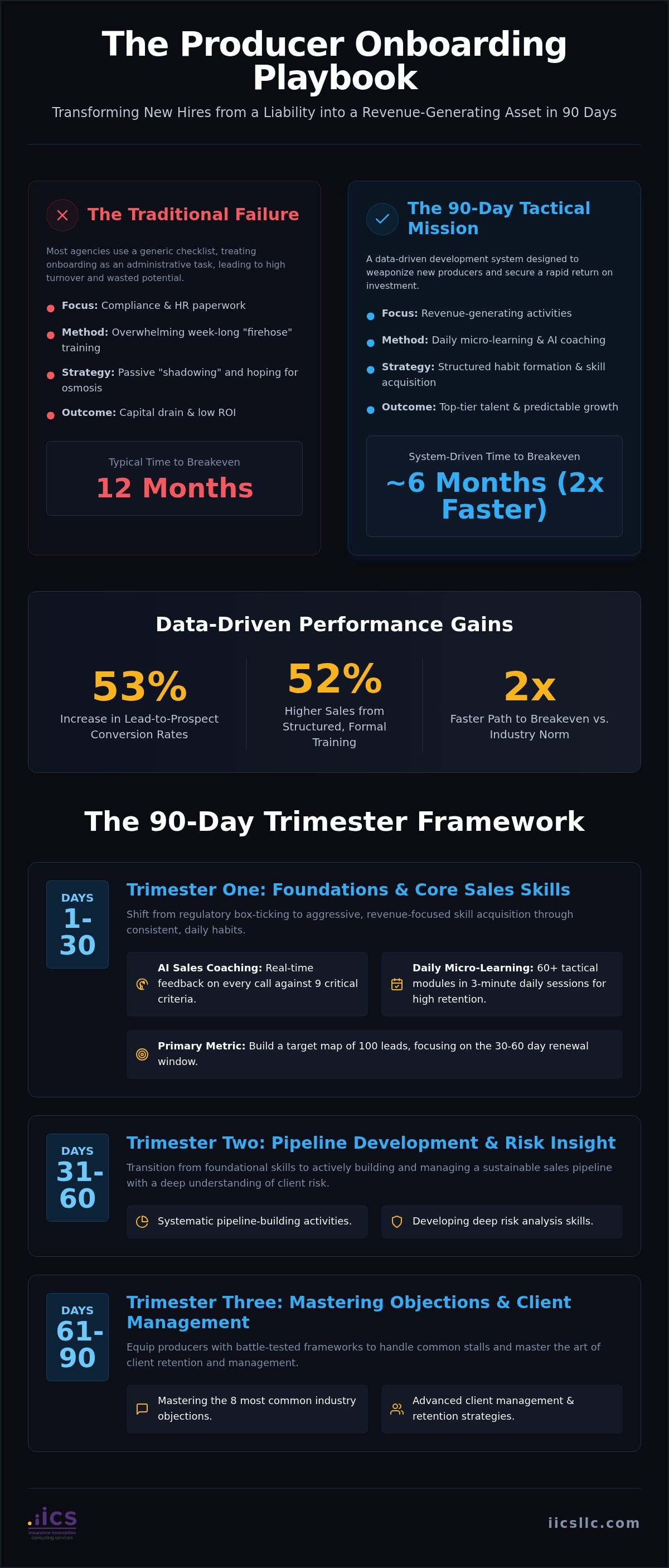
The role of Independent insurance agents is to solve complex risk problems, yet most onboarding treats them like data entry clerks. When you prioritize "shadowing" over structured development, you're hoping for osmosis. Hope is not a strategy. The cost of this stagnation is staggering. Industry norms suggest a 12-month ramp-up time, but this is an unacceptable drain on agency capital. Elite performance requires a shift from passive observation to a tactical mission. You aren't just hiring a person; you're making a high-stakes investment that needs to pay out quickly.
The 90-Day Breakeven Objective
Success starts by setting high-stakes expectations on Day 1. You must define a clear breakeven goal based on your specific agency metrics. Why wait a year for a producer to pay for themselves? Data shows that formal training leads to 52% higher sales, allowing producers to reach breakeven in half the industry norm time. If you aren't tracking these milestones with precision, you're just guessing. A structured system like the one found inside the academy ensures every activity is tied to a revenue outcome. Demand more from your process and your people will follow suit.
The Trimester Framework for Development
To avoid the cognitive overload of traditional training, we divide the first 90 days into three 30-day tactical phases. This trimester framework prioritizes habit formation over information dumping. Instead of a week-long marathon, we utilize daily MicroLearning to ensure retention. It's about small, consistent wins. You don't build a top-tier producer by lecturing them for eight hours. You build them by refining their skills in three-minute bursts every single day. This methodology ensures that by the end of the first trimester, your new hire isn't just "learning" the business. They're actually transacting it.
Trimester One: Foundations and Core Sales Skills
The license is the bare minimum. While producer licensing regulations ensure legal compliance, they don't teach a new hire how to close a commercial account in a bifurcated market. Your insurance producer onboarding checklist must shift from regulatory box-ticking to aggressive skill acquisition. We replace the standard, forgettable weekly seminar with a three-minute daily micro-learning habit. Why? Because daily micro-learning builds permanent neural pathways while weekly seminars just create temporary notes that end up in the trash.
This is where most agencies fail. They let new producers "wing it" on the phone without a safety net. We integrate AI Sales Coaching to provide real-time feedback on every initial call. This isn't just about recording conversations; it's about scoring them against nine critical performance criteria that separate elite producers from the average. If you aren't measuring the quality of the conversation, you're gambling with your leads. You can see the full curriculum of these tactical modules inside the academy to understand the depth of this training.
Tactical Skill Acquisition
We deploy 60 tactical modules from the Sales Academy to ensure every producer speaks the language of risk with precision. These aren't generic sales tips. They're battle-tested strategies for the 2026 market where liability rates are climbing. By using AI to analyze every interaction, we eliminate the guesswork. You'll know exactly where a producer is faltering before it costs you a prospect. It turns a subjective "gut feeling" about a new hire into a data-driven performance report.
The First 30-Day Metrics
Activity is the only lead indicator that matters in the first month. We demand a primary list of 100 leads categorized by expiration dates. This isn't a "suspect" list; it's a target map. By focusing on expiration dates, we ensure the producer is hunting when the renewal window is open. Producers who follow this structured path see specific, measurable results:
A 53% increase in lead-to-prospect conversion rates compared to untrained peers.
Completion of the first 20 micro-learning modules focused on carrier appetite.
Active participation in weekly live peer workshops to sharpen responses to real-world scenarios.
This isn't about hope. It's about building a pipeline that actually flows. If your new hire isn't hitting these markers by day 30, you don't have a training problem; you have a personnel problem. Address it now before the investment becomes a loss.
Trimester Two: Pipeline Development and Risk Insight
By day 31, the honeymoon period is over. Your insurance producer onboarding checklist must now pivot from internal mechanics to external conquest. The goal is no longer just making calls. It is about identifying the specific renewal buying window with surgical precision. If your producer calls a prospect four months before their policy expires, they are wasting breath. If they call two weeks before, they are already too late. We utilize a Window Trigger Map to ensure outreach hits exactly 60 to 60 days before expiration. This captures the prospect just as they begin to feel the friction of their current renewal. This is how we transition from a list of suspects to a pipeline of qualified prospects who are actually ready to buy.
Deep Dive into Carrier Appetite
Placing business in a 2026 split market requires more than a friendly personality. It requires technical mastery of carrier appetite. Producers must understand the difference between standard ISO forms and the custom proprietary endorsements that can leave a client exposed. Are they comfortable explaining completed-operations coverage to a contractor? Can they identify a restrictive professional liability exclusion? We use the Risk and Coverage Deep Dive worksheet to force new hires into the weeds of policy language. As they expand their reach across state lines, they must also remain vigilant about State-specific licensing requirements to ensure every quote is compliant. Technical competence is the foundation of professional trust. Without it, your producer is just another quote-peddler.
Outreach Timing and Strategy
Consistency is the only antidote to a dry pipeline. We demand a minimum of 100 new leads generated every month. This isn't a suggestion. It is a requirement for survival. Outreach must be surgical. Beyond cold outreach, we expect producers to penetrate local networking circles with three concrete actions: identifying a center of influence, securing a formal introduction, and providing a specific risk insight that their current agent missed. This moves the conversation from price to value. Are they tracking these interactions in the CRM with the same precision they use for their personal finances? They should be. A producer without a data-driven pipeline is just a high-paid hobbyist. Success in trimester two is measured by the quality of the prospect, not the volume of the noise.
Trimester Three: Mastering Objections and Client Management
By the third trimester, the training wheels come off. If your insurance producer onboarding checklist hasn't prepared your hire to dismantle the most common industry objections, you've failed them. Most producers freeze when they hear, "I'm happy with our current agent." It's the ultimate conversation killer. But for an elite producer, it's an invitation to audit. We teach a specific framework that pivots from relationship-based loyalty to risk-based reality. Are they actually happy, or are they just comfortable? In a 2026 market where property premiums are dropping while liability exposure expands, "happy" is a dangerous state for a business owner. Your producer's job is to close the gap between current coverage and actual risk. They should be closing 3-5 new accounts per month by this stage.
Managing renewals requires more than a calendar reminder. It requires a tactical approach to the 2026 market where property rates have declined by an average of 5.5%. When premiums decrease, average agents get lazy. We teach producers how to use these market shifts to highlight coverage gaps that were previously too expensive to fix. It's about repositioning the savings into better protection for liability lines where rates are still climbing. This level of sophistication is what separates a professional from a mere policy-peddler. If they don't understand the nuances of the current ISO forms, they can't sell the value of the switch.
Advanced Closing Techniques
Closing isn't about being a "closer." It's about being an expert. We leverage AI-assisted industry insights to provide real-time risk examples that a generic agent will miss. In virtual meetings, we refine the mechanics: eye contact, pacing, and translating complex forms into plain language. It's about authority. We also instill a disciplined follow-up system. There is a thin line between persistence and annoyance. We teach producers how to walk it. They don't just "check in." They provide new value with every touchpoint. This ensures they remain top-of-mind when that renewal window finally opens.
Final Performance Benchmarks
The final 30 days of the 90-day system are about cementing habits. We look for a 31% increase in new client acquisition compared to baseline expectations. By Topic 40, the 90-day habit commitment is no longer a chore; it's a standard of operation. This is the moment of truth. The producer is no longer just a trainee. They are a revenue-generating asset ready to transition from the Academy to full production. If they've followed the system, they've already doubled the likelihood of becoming a top-tier talent.
Ready to stop guessing and start growing? See how the Sales Academy transforms new hires into elite producers.
Scaling Your Agency with a Structured Sales Academy
Scaling an agency requires a shift from being the primary producer to becoming a strategic leader. If you're still the one teaching new hires how to read a dec page or navigate basic carrier portals, you aren't leading; you're babysitting. Outsourcing your producer development is the only way to build a repeatable revenue machine that doesn't depend on your personal output. By integrating a professional insurance producer onboarding checklist into an external, expert-led system, you ensure that every hire receives the same elite level of training regardless of how busy your week gets. Many firms now use platforms like how.io to automate the education and certification of their external partners. This isn't just about saving your time. It's about ensuring that your agency's growth is driven by a data-backed methodology rather than luck.
Expertise matters in a competitive market. We provide access to four decades of commercial P&C leadership experience, distilled into a 90-day mission. You can review the full details of our tactical modules Inside the Academy to see exactly how we bridge the gap between basic licensing and elite production. For invited agencies ready to take action, use the discount code Summer2026 to secure the $1,500 monthly rate. This is a high-stakes investment in your agency's future. Don't let a mediocre onboarding process be the reason your next hire fails to produce.
Continuous Improvement and Mentoring
Accountability is the glue that holds a high-performance sales culture together. Our system includes 1:1 call coaching and weekly live workshops where producers are challenged to defend their strategies in front of their peers. It isn't enough to just watch a video. They must perform under pressure. This environment of constant feedback ensures that the habits formed in the first 90 days stay locked in for the long haul. It creates a standard of excellence that permeates the entire agency, from the newest hire to the seasoned veteran. You don't have to manage this process alone. Ready to transform your next hire into a revenue engine? Enroll your producers in the Sales Academy and start scaling with precision today.
Stop Renting Potential and Start Owning Performance
The difference between a failing agency and an elite firm isn't the quality of the leads. It's the rigor of the development system. You've seen why a standard insurance producer onboarding checklist fails when it ignores the tactical reality of the 2026 market. By shifting to a 90-day trimester framework, you replace administrative busywork with revenue-generating habits. You move from hoping a hire works out to ensuring they reach breakeven in half the industry norm time. It's time to stop funding your competitor's future talent and start building your own.
Led by Ralph Blust with over 40 years of industry expertise, our Sales Academy delivers 52% higher sales for graduates. While retail tuition is $3,000 per month, invited agencies can access this battle-tested system for $1,500 per month using code Summer2026. Don't let another 12-month ramp-up drain your capital. Join the Premier Sales Academy for Commercial P&C Producers and turn your next hire into a top-tier asset. Your agency's future depends on the standards you set today.
Frequently Asked Questions
What should be on an insurance producer onboarding checklist?
An effective insurance producer onboarding checklist must prioritize tactical revenue generation over administrative paperwork. It includes daily microlearning targets, AI-scored call quotas, and the identification of 100 expiration-dated leads within the first 30 days. Don't settle for a list of HR forms. Your checklist should be a 90-day mission map that forces the hire to engage the market immediately. If it doesn't drive sales, it doesn't belong on the list.
How long does it take to ramp up a new insurance producer?
While the industry average for a producer to reach breakeven is 12 to 18 months, an elite system cuts that time in half. Our 90-day Sales Academy is designed to move a new hire from a liability to a revenue-generating asset in just one fiscal quarter. Speed is a competitive advantage. You can't afford to fund a new hire's learning curve for a year. Demand results within the first 90 days.
What are the most important skills for a commercial P&C producer?
A successful 2026 producer needs technical mastery of carrier appetite and the ability to navigate a split market. They must explain why property rates are softening while liability premiums climb. Beyond technical knowledge, the most critical skill is disciplined pipeline management. They need to hunt within the 60 to 90 day renewal window. Without this timing, even the best sales pitch falls on deaf ears in a competitive landscape.
How much does elite insurance producer training cost?
Elite training is an investment in a high-yield asset, not a sunk cost. Retail tuition for our Sales Academy is $3,000 per month. However, invited agencies can utilize the discount code Summer2026 to secure a 50% reduction, bringing the cost to $1,500 per month. When you consider that formally trained agents produce 52% higher sales, the ROI of professional development far outweighs the price of stagnation or high turnover.
Why do most insurance producers fail in their first year?
Most first-year producers fail because they lack a repeatable, data-driven framework for handling objections. They get buried under a "firehose" of technical information during week one and forget 90% of it by week two. Without a structured framework to guide daily habits, they eventually run out of friends and family leads. They fail because they were never taught how to prospect a cold commercial market with surgical precision.
How can AI sales coaching improve producer performance?
AI sales coaching removes the subjectivity from performance reviews by scoring calls against nine critical sales criteria. It provides producers with real-time feedback that an overextended principal simply can't offer. This technology is a primary driver behind the 53% increase in lead-to-prospect conversion rates seen by our students. It ensures every phone interaction is a training opportunity rather than a missed chance to secure a new commercial account.
What is the role of microlearning in insurance sales training?
Microlearning builds permanent neural pathways through short, three-minute daily bursts of high-impact information. Seminars are forgettable events; microlearning is a habit. In the high-stakes world of P&C sales, retention is everything. By delivering training in small doses, we ensure producers actually apply what they learn before the next lesson begins. It's the difference between a one-time lecture and a transformative development system that sticks for the long haul.
How do I track a new producer’s progress during onboarding?
You track progress through leading indicators like call quality scores, lead list depth, and renewal window identification. Lagging indicators like premium written are useful but often arrive too late to fix a failing hire. Use a structured insurance producer onboarding checklist to monitor if they're completing daily modules and participating in weekly workshops. If the activity is right, the revenue will follow. If the activity is missing, the hire is doomed.