The Ultimate Insurance Sales Coaching Framework for Elite P&C Producers (2026)
Updated: Sep 10
Why are you still waiting 24 months for a new producer to stop draining your agency's capital? Most agency leaders accept high turnover and agonizingly slow ramp-up times as an unavoidable tax on growth. They're wrong. You've likely felt the frustration of watching promising talent wither under generic training that ignores the high-stakes complexities of the 2026 Commercial P&C market. In an environment where social inflation is outpacing economic inflation at a rate of 5.4%, relying on passive "shadowing" is a recipe for stagnation.
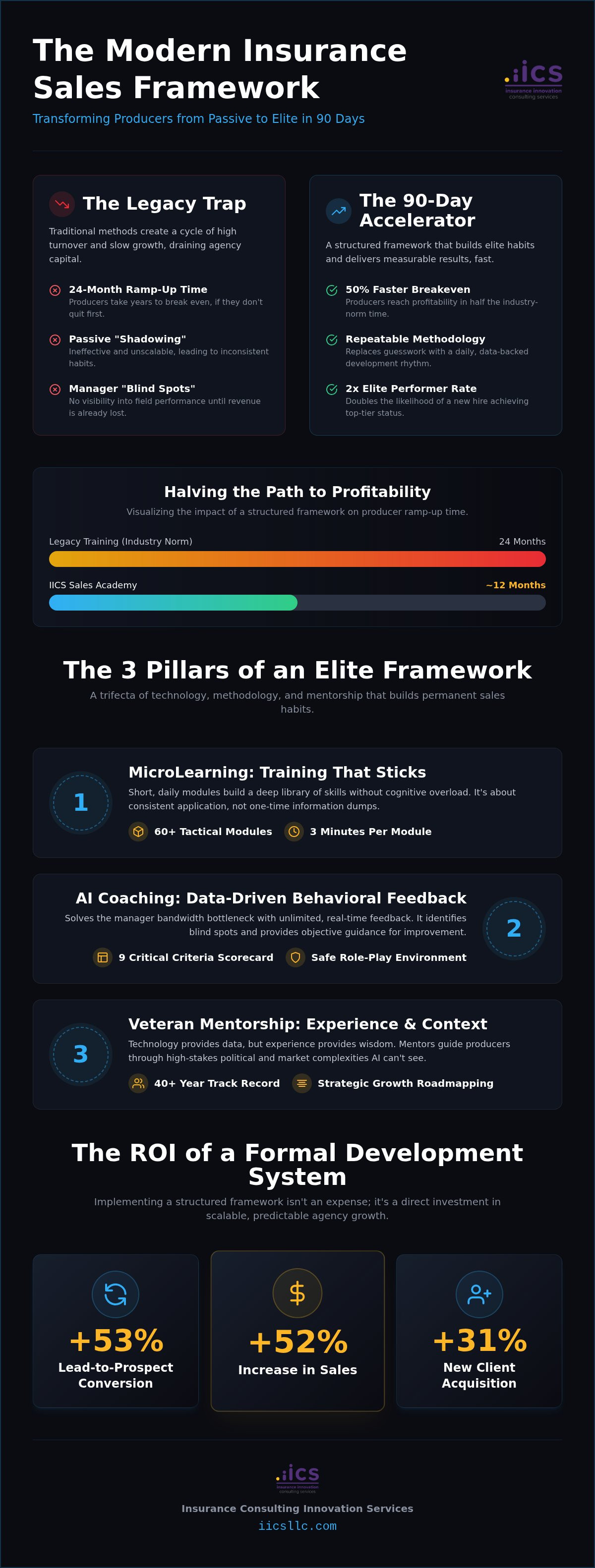
To dominate this cycle, you need a rigorous insurance sales coaching framework that transforms behavior rather than just delivering information. Our 90-day Sales Academy system doubles the likelihood of a hire reaching elite status by replacing guesswork with a repeatable, data-backed methodology. We've proven that producers can reach breakeven in half the industry norm time when they're equipped with the right tools. This guide breaks down the transition from passive management to elite performance through AI precision, microlearning, and structured daily development.
Table of Contents
What Is an Insurance Sales Coaching Framework?
An insurance sales coaching framework is a 90-day behavioral transformation system that integrates technical P&C knowledge with high-stakes behavioral sales skills. It's not a monthly check-in or a scattered collection of "best practices." Instead, it's a daily, repeatable development rhythm designed to move producers from passive order-takers to elite consultants. While many managers confuse instruction with development, a true framework provides the infrastructure for consistent, measurable growth. It bridges the gap between understanding a concept and executing it under the pressure of a complex commercial negotiation.
Elite performance is never accidental. It's the result of a system that replaces guesswork with precision. A robust insurance sales coaching framework ensures that every interaction follows a battle-tested process. It moves beyond the foundational definition of coaching to focus on habit formation. If your current approach lacks a daily feedback loop, you don't have a framework; you have a hope-based strategy. This system replaces that uncertainty with a structured path to mastery.
The Failure of Legacy Training Models
Classroom seminars and static e-learning modules fail because they treat learning as a one-time event. This creates the "Blind Spot" crisis. Managers have zero visibility into field performance until the revenue numbers come in low. By then, the damage is done. Relying on occasional 1:1s creates a scalability bottleneck where manager bandwidth can't keep up with producer needs. Without real-time visibility, bad habits become permanent fixtures of your agency's sales culture.
The ROI of a Formal Development System
The data is clear. Agencies using a formal development system see a 52% increase in sales and a 31% rise in new client acquisition. Formal training drives a 53% increase in lead-to-prospect conversion. By implementing the Sales Academy methodology, producers reach breakeven revenue in half the industry norm time. This isn't just a minor improvement; it's a fundamental shift in the cost of talent. You stop subsidizing underperformance and start accelerating your return on every new hire.
The 3 Pillars of an Elite Producer Framework
MicroLearning: Training That Actually Sticks
Most agencies treat training like a one-time injection. They send producers to a three-day seminar and expect a permanent shift in results. This approach ignores the science of habit formation. The Sales Academy utilizes 60 tactical MicroLearning modules, each lasting only three minutes. These short, daily bursts of information are designed to be consumed and applied immediately. By focusing on one specific skill per day, producers avoid the cognitive overload of "firehose" learning. This method builds a massive internal library of effectiveness tools and workbooks that producers can reference during real-world negotiations.
AI Coaching: Data-Driven Behavioral Feedback
Manager bandwidth is the single greatest bottleneck in agency growth. Most managers simply don't have the time to listen to every prospecting call. AI Sales Coaching solves this by providing unlimited, real-time feedback on every interaction without human intervention. The system scores calls against nine critical criteria, identifying missed opportunities and behavioral "blind spots" that even seasoned managers might overlook. Producers can practice objection scripts in a safe role-play environment before they ever pick up the phone for a real prospect. This data-driven approach ensures that "next-step" guidance is based on objective evidence rather than gut feelings.
The Role of the Veteran Mentor
Technology provides the data, but experience provides the context. AI cannot replace the nuance of 40 years in Commercial P&C leadership. While the software identifies what was said, a mentor explains why it mattered in the context of the current market cycle. High-level producers need more than just tactical skills; they need a strategic roadmap for agency growth. Linking with experts who have a 40-year track record of growth ensures that your producers aren't just winning battles, they're winning the war. Agencies looking to modernize their sales culture often find that the Sales Academy provides the exact structure needed to scale without burnout.
Peer accountability rounds out these pillars through weekly live workshops. These sessions foster a competitive yet collaborative environment where producers share wins and dissect losses. When you combine daily MicroLearning, objective AI feedback, and veteran mentorship, the result is a repeatable sales process that delivers consistent, elite-level revenue.
The 90-Day Ramp-Up: A Trimester Roadmap
The 90-day window is the critical period for producer survival; it's the razor's edge between a future partner and a costly turnover statistic. Most agencies treat the first three months as a "getting to know you" phase. That's a mistake. You're burning capital while your new hire wanders aimlessly through your CRM. An elite insurance sales coaching framework eliminates this drift by enforcing a strict trimester roadmap. Each 30-day block has non-negotiable objectives designed to transform a raw hire into a revenue-generating asset in record time. We create a culture of consistency and accountability from day one, ensuring that every action is tied to a measurable outcome.
Month 1: Foundations and Core Sales Skills
Mindset precedes mechanics. During the first 30 days, the Sales Academy curriculum (Topics 1-20) focuses on establishing the psychological profile of an Elite Producer. We strip away the "order taker" mentality and replace it with a consultant's edge. Producers master the creation of a "Suspect List" and learn to identify specific buying windows based on industry data. Pipeline development isn't a suggestion; it's a daily discipline. By the end of Month 1, the producer doesn't just know what to say; they know exactly who to say it to and why. They aren't just making calls; they're hunting opportunities with precision.
Month 2: Pipeline Development and SME Accounts
In the second trimester, the focus shifts to active sales cycles. Topics 21-40 move the producer into the world of Small to Medium Enterprise (SME) accounts. These accounts are the lifeblood of a stable book, providing the volume necessary to build momentum and confidence. Producers learn to map social circles and take concrete networking actions that go beyond generic "mixer" events. They start managing active opportunities and utilizing AI feedback to refine their pitch against nine specific criteria. This is where the theoretical becomes tactical. We demand consistency in lead generation to ensure the pipeline never runs dry, even when the initial excitement of the new role begins to fade.
Month 3: Advanced Scenarios and Renewals
The final 30 days address the complexities of a shifting market. Research shows the commercial P&C market entered a softening phase in early 2026, with average premiums declining 1.2% in Q1. Producers must learn soft-market tactics to maintain their value proposition when rates aren't doing the selling for them. Topics 41-60 cover complex selling scenarios and personal brand building. We emphasize winning through basics: committing to the habits that sustain long-term growth. By day 90, the producer isn't just "ramped up." They're a disciplined professional with a repeatable process and a clear path to profitability.
Tactical Execution: Mastering Commercial P&C Sales
Generic sales training is a liability in the complex world of Commercial P&C. It teaches producers how to be "likable" while ignoring the technical nuances that actually build trust with sophisticated buyers. If your producer can't explain why a proprietary carrier form leaves a client exposed compared to a standard ISO form, they aren't a consultant; they're a brochure-passer. Elite performance requires a deep dive into industry-specific risk insights. Within our insurance sales coaching framework, we demand a high-volume prospecting discipline, setting a minimum floor of 100 suspects per month. This isn't just about activity; it's about building the statistical probability of success. We utilize AI-assisted prompts to help producers develop these insights rapidly, allowing them to speak the language of a CFO or Risk Manager from day one.
Overcoming the "Happy with My Current Agent" Objection
The "happy with my agent" line is rarely a statement of fact; it's a defensive reflex. To break this stall, producers must master six thematic response approaches that pivot the conversation from price to risk. Most producers fail here because they try to sell a policy. Elite producers sell a gap analysis. By using "Window Trigger Maps," our producers identify the critical 30 to 60 day buying window where the incumbent agent is most vulnerable. We teach them to uncover coverage gaps that the current agent likely missed during a lazy renewal cycle. This is especially vital in 2026 as carriers tighten underwriting standards on casualty lines despite the broader market softening. A producer's success depends on their ability to:
Shift the narrative from premium savings to total cost of risk.
Identify specific triggers that make an incumbent agent's service model obsolete.
Execute a "wedge" strategy that highlights the incumbent's lack of technical oversight.
Technical Mastery: ISO vs. Custom Forms
Agencies often hit a growth ceiling because the principal remains the primary revenue driver. This creates a dangerous dependency. To break this cycle, you must move from individual producer development to holistic agency growth. Scaling requires an insurance sales coaching framework that functions independently of your daily oversight. It's about installing a system that replicates elite performance across your entire roster. This shift turns your agency into a predictable revenue engine rather than a collection of independent contractors. When you prepare for 3-6x annual growth, you aren't just looking for more leads; you're building the infrastructure to handle them with precision.
The choice between outsourced producer development and internal management is often a choice between results and stagnation. Most managers simply don't have the 1:1 time required to forge elite talent. By the time they realize a producer is failing, thousands of dollars in draw and opportunity costs have already vanished. Outsourcing this development to a specialized system ensures consistency that internal teams rarely achieve. It provides a structured scaling model that allows the agency principal to focus on high-level strategy while the revenue engine runs on autopilot.
The Fractional CRO Advantage
Most mid-sized agencies lack the capital for a full-time, six-figure Chief Revenue Officer. However, they desperately need that level of strategic oversight to navigate the 2026 market. A Fractional CRO provides executive-level sales leadership without the C-suite salary burden. This role modernizes your sales leadership by implementing weekly live workshops and rigorous peer accountability. It ensures that the AI Sales Coaching for Insurance tools you've deployed are actually driving the behavioral changes necessary for elite performance. This executive oversight removes the "Blind Spot" crisis by providing data-driven visibility into every sales cycle in your pipeline.
Getting Started: The IICS Sales Academy
Elite production isn't a gift; it's a discipline. The Sales Academy allows you to enroll producers in the next trimester, which begins on the 1st of every month. This is the most direct path to implementing a high-performance insurance sales coaching framework within your agency. We provide the 90-day behavioral transformation system that has been battle-tested over a 40-year track record of growth. For a limited time in 2026, you can take advantage of a 50% "invited-agency" discount by using the code Summer2026 at checkout. Don't settle for the industry norm of 24-month ramp-up times. Apply for the Sales Academy today and start building the elite team your agency deserves.
Forge Your Agency's Future with Precision
The window for accepting mediocre producer performance has closed. To win in the 2026 market, you must move beyond hope and install a rigorous insurance sales coaching framework that demands excellence. You've seen how integrating AI-driven behavioral feedback with a structured 90-day trimester roadmap can cut ramp-up times in half. Why continue to subsidize the long, expensive learning curves of legacy training models?
Elite production isn't a mystery; it's a discipline backed by our 40-year track record of elite performance. By implementing the Sales Academy, you replace management "blind spots" with data-driven precision. It's time to stop managing activities and start coaching outcomes. For a limited time, you can secure this transformation at a significant value. Enroll your producers in the IICS Sales Academy today and use code Summer2026 to receive a 50% invited-agency discount. Your path to a 3x growth engine starts with a single, decisive action. We look forward to seeing your team at the top.
Frequently Asked Questions
What is an insurance sales coaching framework?
Elite performance is never an accident. An insurance sales coaching framework is a 90-day behavioral transformation system that moves producers from order-takers to elite consultants. It combines daily microlearning, AI-driven feedback, and veteran mentorship into a repeatable rhythm. This infrastructure ensures that every interaction follows a battle-tested process. It's designed to build permanent habits rather than just delivering information. By focusing on technical P&C knowledge and behavioral skills, it provides the foundation for long-term production success.
How long does it take to ramp up a new insurance producer?
The industry norm for ramping up a new producer is often 18 to 24 months. This timeline is dangerously slow for most agency budgets. Graduates of the Sales Academy achieve breakeven revenue in half that time by following a structured trimester roadmap. We focus on the critical first 90 days. This sets the habits that sustain long-term growth. This accelerated path reduces the cost of non-producing hires and turns new talent into revenue-generating assets faster.
Can AI really coach an insurance agent as well as a human?
AI provides a level of objective, unlimited feedback that human managers simply can't match. It scores every call against nine specific criteria. It identifies behavioral blind spots in real time. While AI handles the tactical frequency of coaching, it doesn't replace the strategic nuance of a veteran mentor. The most effective systems use AI to build the foundation. Human experts then guide producers through high-stakes commercial negotiations and agency growth strategies.
What are the most common objections in commercial P&C sales?
The most frequent hurdle is the "happy with my current agent" reflex. Other common objections include price sensitivity and coverage limit satisfaction. We teach producers six thematic response approaches to pivot these conversations. Don't argue about premium. Elite producers focus on risk gaps. By using Window Trigger Maps, they identify the 30 to 60 day buying window. This is when an incumbent agent is most vulnerable during a lazy renewal cycle.
How much does a professional insurance sales academy cost?
Professional sales development is an investment in your agency's long-term equity. While costs vary based on the level of executive involvement, the Sales Academy provides a comprehensive 90-day system with no hidden fees. Agencies can currently access a 50% invited-agency discount for 2026 by using the code Summer2026. This investment covers unlimited AI coaching, microlearning modules, and 1:1 sessions with industry veterans. It's a high-stakes commitment to reaching the top tier of the profession.
What is the difference between ISO and custom insurance forms?
ISO forms like the CG 00 01 are industry standards used by most carriers. Custom forms are unique to specific insurers. They often contain subtle wording differences that create catastrophic risks for your clients. Elite producers must identify at least three specific wording differences to win complex deals. Understanding these nuances allows you to speak the language of risk management. It's the technical edge that separates a professional consultant from a generic insurance agent.
How many leads should a new producer generate per month?
A new producer should generate a minimum of 100 leads or "suspects" every month based on specific policy expiration dates. This volume is the fuel for a repeatable sales process. Outreach should begin 60 to 90 days before expiration. You must hit the critical 30 to 60 day renewal buying window. It's the only way to win. Targeting 10 to 100 employee accounts ensures a stable book. This volume secures 3 to 5 new accounts monthly.
Why do most new insurance producers fail in their first year?
Most producers fail because they lack a structured insurance sales coaching framework to guide their first year. High turnover is the direct result of long ramp-up times and a lack of consistent 1:1 mentorship. Without a daily development rhythm, new hires fall into the "order taker" trap. They fail to build a sustainable pipeline. Agencies that provide outsourced development and AI-driven feedback see a 53% increase in lead-to-prospect conversion. This significantly reduces the risk of failure.