When to Hire a Fractional CRO for an Insurance Agency: The 2026 Growth Blueprint
Updated: Sep 15
If your agency’s growth depends entirely on your personal ability to close commercial accounts, you don't have a scalable business. You have a high-stakes, high-stress job that will eventually break. Is your current strategy for scaling revenue based on actual data, or is it just a hope that your next producer hire finally hits their numbers? Understanding exactly when to hire a fractional CRO for an insurance agency is the difference between an elite firm that scales and one that suffocates under the weight of its own founder.
You've likely felt the frustration of fragmented marketing and a sales pipeline that feels more like a guessing game than a predictable engine. You agree that the status quo is no longer enough to win as commercial P&C premiums decline for the first time in nearly a decade. This blueprint identifies the precise inflection points where you need elite revenue leadership without the $416,766 price tag of a full-time executive. We will examine how to install a repeatable system for ramping producers twice as fast as the industry norm and gain total visibility into your sales forecast. It is time to stop being the bottleneck and start building a machine that produces results without your daily intervention.
Table of Contents
What is a Fractional CRO for an Insurance Agency?
Most agency principals are playing a dangerous game of revenue whack-a-mole. They fix a marketing problem today only to find a producer retention issue tomorrow. A Fractional Chief Revenue Officer (CRO) is a senior level veteran who ends this cycle by owning the entire customer journey, from the first digital touchpoint to the final renewal. They don't just manage people; they build the infrastructure that makes growth inevitable. The Fractional CRO is the architect of a repeatable revenue engine for P&C agencies.
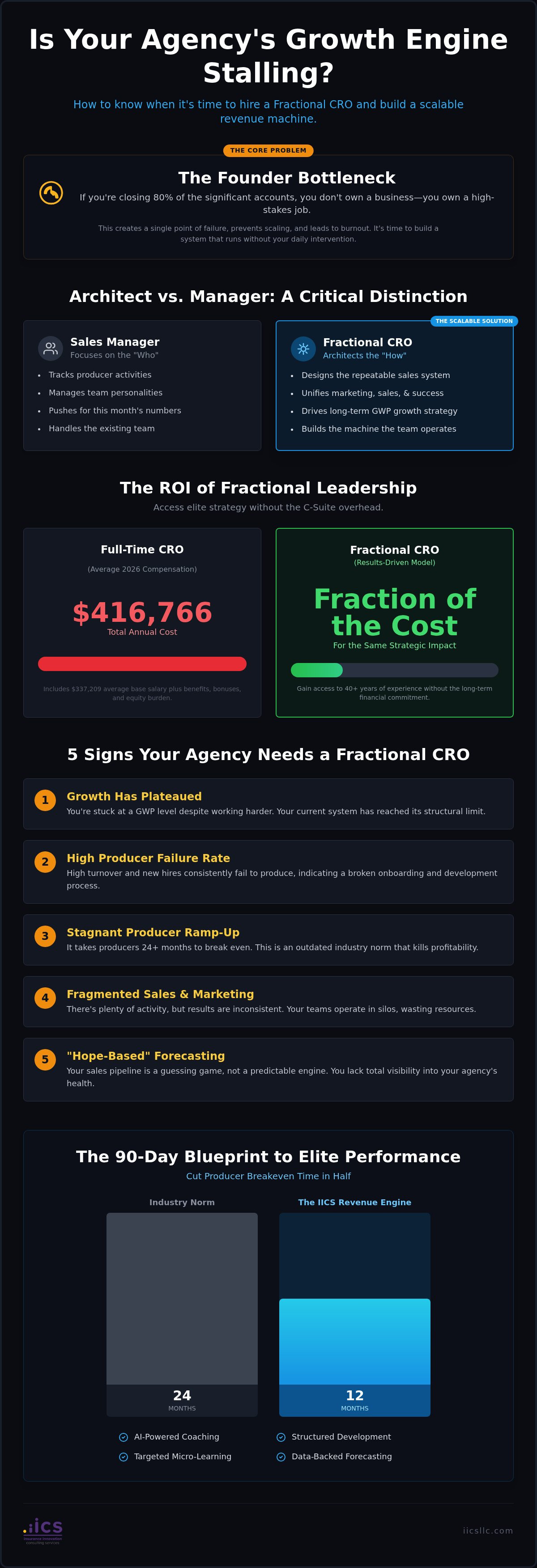
In the specific context of insurance, this role goes beyond generic sales leadership. It requires a deep understanding of how to align sales activity and marketing spend with carrier appetite and current market cycles. While a full time CRO in 2026 commands an average base salary of $337,209 plus benefits, a fractional executive provides that same elite leadership for a fraction of the cost. This allows agencies to access 40 years of proven experience without the long term equity burden. Knowing when to hire a fractional CRO for an insurance agency determines whether you remain a lifestyle business or become a market leader.
The Difference Between a Sales Manager and a Fractional CRO
Don't confuse a CRO with a sales manager. Sales managers focus on the "who." They track activities, manage personalities, and push for this month's numbers. A CRO focuses on the "how." They architect the system. Instead of looking at individual producers in a vacuum, the CRO unifies marketing, sales, and customer success to eliminate silos. They are responsible for the long term GWP growth strategy. While a manager handles the team, the CRO builds the machine the team operates. If your agency has plenty of activity but inconsistent results, you don't have a people problem; you have a system problem.
Why the Fractional Model is the 2026 Standard for Agencies
For agencies generating between $5M and $50M in GWP, the math for a full time revenue executive rarely adds up. You need the high level strategy, but you don't need the overhead. The fractional model has become the 2026 standard because it prioritizes results over administrative seat warming. You gain access to veterans who have turned massive deficits into high value EBTA. This isn't about hiring a part time employee. It's about installing a framework, like the Sales Academy system, that ensures your producers reach breakeven twice as fast as the industry norm. This approach provides the precision of elite performance without the financial risk of a C-suite hire.
5 Signs Your Agency Needs a Fractional Chief Revenue Officer
Growth plateaus are rarely caused by a lack of effort. Often, they are the result of a system that has reached its structural limit. If your agency is struggling to break through to the next level of GWP despite increasing your lead volume or hiring more producers, the problem is likely at the executive level. Identifying when to hire a fractional CRO for an insurance agency is about recognizing these specific, high stakes triggers before they lead to permanent stagnation. Are you leading a scalable machine, or are you just running faster on a treadmill that isn't moving?
The Founder Bottleneck: Why Your Agency Can’t Scale Without You
Waiting 24 months for a producer to reach breakeven is an outdated industry norm that you should not accept. Elite agencies aim for half that time. If your turnover is high and your new hires are failing to produce, your onboarding process is broken. You can read more about The Real Cost of a Non-Producing Hire to see the financial drain this causes. A Fractional CRO implements structured development, such as the IICS Sales Academy, to transform raw talent into high performing P&C producers with surgical precision. This isn't just training. It is a battle tested framework for immediate ROI.
Fragmented Marketing and Carrier Appetite Misalignment
Is your marketing department generating leads that your producers simply cannot place? This is a classic symptom of a fragmented revenue engine. A CRO ensures that your outreach is filtered by carrier appetite and specific effective dates. They standardize a "Window Trigger Map" for outreach 60 to 90 days before expiration. This level of precision ensures that your "Suspect List" is filled with high probability targets that match your carrier sweet spots. If your sales forecast is still based on "gut feel" rather than a data driven model, you are ready for elite leadership. Exploring the Sales Academy is often the first step toward fixing these misalignments and securing your agency's future.
The ROI of Fractional Leadership: Full-Time vs. Fractional
The financial burden of a full time C-suite hire is often the primary deterrent for scaling agencies. In 2026, the average annual salary for a full time CRO sits at $337,209. This figure does not even account for bonuses, equity, or the heavy tax burden of benefits. For an agency with $10M to $50M in GWP, this is an unsustainable overhead. Fractional engagements, by contrast, are priced by scope and results. This typically saves agencies 70% in overhead while delivering the same high level strategic direction. Deciding when to hire a fractional CRO for an insurance agency is a tactical decision to trade fixed costs for variable, high impact results.
Beyond the payroll savings, the real ROI lies in the elimination of waste. The industry norm of 24 months for a producer to reach breakeven is a slow motion disaster for your balance sheet. Achieving breakeven in 12 months versus 24 months pays for the CRO engagement multiple times over. When you cut that ramp up time in half, you aren't just saving on a salary; you are accelerating the arrival of profitable revenue. This is the difference between a firm that survives and one that dominates.
Avoiding the "Sales Manager" Trap
Many Principals attempt to solve their growth issues by hiring a mid level sales manager. This is a mistake. Mid level managers focus on "babysitting" producers and managing personalities. They don't build systems. A Fractional CRO brings the "Elite Producer Blueprint" used by national brokerages to your firm. Statistics show that agents who attend formal, led development achieve 52% higher sales than those left to their own devices. You don't need a babysitter. You need an architect who can install a repeatable sales system.
The Speed of Implementation Advantage
A veteran CRO doesn't "learn on the job." They arrive on day one and begin installing 40 years of proven systems immediately. Tools like the "Sales Cycle Snapshot" and "Lead Source Menu" are deployed to gain instant clarity on your pipeline health. Consider the example of Pathpoint, which scaled from $0 to $100M GWP by utilizing structured leadership and rigorous development frameworks. This isn't a theoretical exercise. It is a battle tested methodology. By choosing elite fractional leadership, you bypass years of trial and error and move straight to the execution phase of your growth blueprint.
The First 90 Days: Installing the IICS Revenue Engine
Elite agencies don't leave revenue to chance. When you decide when to hire a fractional CRO for an insurance agency, you aren't just buying part-time help; you are buying a 90-day transformation. This period is not about vague strategy meetings or administrative "seat-warming." It's about installing a repeatable, data-driven system that outlasts any single executive. We break this down into three distinct, high-impact phases designed to move the needle immediately.
Phase 1 (Days 1-30): We audit the current pipeline and map the 60 to 90 day renewal buying windows to ensure your team is hunting where the money actually is.
Phase 2 (Days 31-60): We implement tactical micro-learning and AI call coaching for the producer team to enhance performance in real-time.
Phase 3 (Days 61-90): We standardize the "Winning Through Basics" habit loop, turning elite performance into a daily requirement rather than an occasional accident.
Auditing the Sales Cycle and Pipeline Health
Most agencies fail because they mistake activity for progress. We use the Small Commercial Focus Filter to distinguish "Suspects" from "Prospects" with surgical precision. If your producers aren't generating at least 100 leads per month, your engine is stalling. Understanding Insurance Agency Sales Performance in 2026 requires looking at the raw data of outreach rather than relying on gut feel. We stop the guessing game and start the measuring game by auditing every stage of your sales cycle.
Deploying the Elite Producer Academy
The IICS Sales Academy is the core of this transformation. We install a 3-month system that integrates daily micro-learning with weekly live workshops. Consider Topic 35. We don't just tell producers to "be better" when a prospect says they're happy with their current agent. We provide six thematic approaches to dismantle that objection. Our AI Sales Coaching then scores those calls against 9 elite performance criteria. This provides the real-time feedback necessary for rapid growth and producer confidence.
Establishing the Operating Cadence
Accountability is the glue of a successful agency. We move your team from "ad-hoc" check-ins to a rigorous weekly operating cadence focused on results. This includes weekly workshops and defining three concrete actions for local networking social circles. Data shows a 31% increase in new clients for agencies that adopt these structured development programs. It's about discipline, not just talent. Ready to see how this framework fits your firm? Explore the Sales Academy and start your 90-day blueprint today.
Elite Agency Growth: The IICS Fractional CRO Advantage
IICS is not a traditional consultancy. We don't just provide suggestions or high level observations. We provide a battle-tested framework for P&C mastery that has been refined over decades. Our fractional services are led by Ralph Blust, a veteran with a 40-year track record of continuous growth and development in the commercial insurance space. We don't just tell you what is wrong with your revenue engine; we install the parts to fix it. Integration with the IICS Sales Academy ensures your producers are developed the right way, reaching breakeven twice as fast as the industry norm. Determining when to hire a fractional CRO for an insurance agency is the single most important decision a principal will make to escape the trap of the daily grind.
Leveraging AI and Mentorship for Scalable Growth
For agency principals, the shift toward automation requires a new set of strategic skills. Participating in an AI leadership accelerator programme UK can provide the necessary foundation to lead an AI-driven organization while maximizing the ROI of new technologies.
Modern growth requires more than just manual oversight. Our AI Sales Coaching provides the unlimited, real-time feedback required for permanent habit formation. It scores every producer call against 9 specific performance criteria, ensuring that no lead is wasted due to poor execution. This technology, combined with 1:1 mentoring from veteran sales experts who have managed billions in premium, creates a scalable growth engine. You can't be everywhere at once, but our systems can. You can review The Elite Insurance Producer Development Plan to see how these tools integrate to scale agency growth in 2026.
Your Path to Victory: Next Steps for Agency Principals
Principals must face a hard truth. If you don't change your system, you cannot change your results. Audit your current producer ramp-up time today. Are you genuinely satisfied with the status quo, or is it just what you have grown used to? Consider the cost of inaction. What is one more year of stagnant GWP or high producer turnover costing your firm in terms of both capital and mental energy? It is time to stop being the primary closer for every account and start being the CEO of a high-performance machine. Learn how IICS Fractional Leadership can transform your agency and secure your path to victory.
Secure Your Agency’s Revenue Future
The era of hope-based growth is over. You now understand that knowing when to hire a fractional CRO for an insurance agency is about identifying the exact moment your ambition outpaces your current infrastructure. If you're still the primary closer for every major commercial account or your producers are taking two years to reach breakeven, you aren't just stagnant; you're falling behind. Stagnation is a choice that carries a heavy price tag in a softening market. It is time to trade the exhaustion of founder-led sales for the precision of a professional revenue engine.
IICS brings a 40-year track record of P&C growth and development to your firm. We don't just offer suggestions. We install a battle-tested system where producers achieve 52% higher sales through formal training and elite AI Sales Coaching with unlimited usage. This isn't a luxury. It's a survival requirement for those who refuse to settle for industry averages. Stop being the bottleneck and start being the architect of a machine that produces results without your daily involvement.
Explore the IICS Sales Academy and Fractional Executive Services today. Your path to elite performance and predictable revenue starts with a single, decisive move toward professional leadership. We are ready to help you win.
Frequently Asked Questions
What exactly does a Fractional CRO do for an insurance agency?
A Fractional CRO acts as the chief architect of your revenue engine, unifying sales, marketing, and carrier appetite into a single predictable forecast. Unlike a part-time employee, they own the entire customer journey from the initial suspect list to the final renewal. They install high-performance systems like the IICS Sales Academy to ensure your producers aren't just busy but are actually profitable. They remove the Principal from the daily sales grind.
How is a Fractional CRO different from an insurance sales consultant?
Consultants typically provide advice and then leave the difficult task of implementation to you. A Fractional CRO is an executive leader who takes ownership of the results and manages the daily execution of the strategy. They don't just tell you what is wrong; they fix it by installing battle-tested frameworks and accountability loops. It is the difference between buying a map and hiring a navigator to steer the ship.
What is the typical cost of a Fractional CRO engagement for a mid-sized agency?
The investment for a fractional leader is significantly lower than the $337,209 average base salary of a full-time CRO in 2026. Because the model is based on scope and specific growth milestones, agencies typically save about 70% in executive overhead while gaining 40 years of elite P&C expertise. This allows mid-sized firms to access C-suite strategy without the long-term equity or benefits burden that often cripples smaller balance sheets.
How long does it take to see results from hiring a Fractional CRO?
You should expect to see structural changes within the first 30 days and measurable revenue impact within 90 days. The process begins with a deep audit of your pipeline health followed by the implementation of daily micro-learning and AI call coaching. By the end of the first quarter, your agency will have a standardized habit loop that produces predictable growth regardless of market volatility. Speed of implementation is a core advantage of this model.
Can a Fractional CRO help with producer recruiting and onboarding?
Yes, they are instrumental in transforming how you bring on talent. A primary reason to determine when to hire a fractional CRO for an insurance agency is to fix high producer failure rates. They install a structured development machine that cuts the industry-standard 24-month breakeven time in half. By using AI coaching and weekly workshops, they ensure new hires are developed the right way from their very first day on the job.
Does my agency need to reach a certain GWP before hiring a Fractional CRO?
Most agencies find the most value between $5M and $50M in GWP. At this stage, the Principal is often the primary bottleneck for large accounts and cannot scale further without professional systems. However, the decision is less about a specific number and more about the complexity of your sales engine. If your revenue has plateaued despite a growing headcount, you have already reached the threshold for elite leadership. Deciding when to hire a fractional CRO for an insurance agency depends on your growth goals.
How does a Fractional CRO work with my existing sales manager?
The CRO and sales manager have complementary roles. The CRO is the architect who designs the revenue system, while the sales manager is the foreman who ensures the team follows the blueprint daily. This partnership prevents the manager from being stuck babysitting and allows them to focus on high-level coaching. The CRO provides the tools, such as AI scoring criteria, that make the sales manager's job significantly more effective and results-driven.
What metrics should I use to measure the success of a Fractional CRO?
Success is measured by the health of your revenue engine. Key metrics include the reduction in producer breakeven time, the volume of new commercial leads generated per producer, and the accuracy of your sales forecast. You should also track improvements in AI-scored call performance and the overall growth of your GWP. Ultimately, the best metric is a scalable agency that no longer requires the Principal's daily involvement to close major deals.