Why Insurance Producers Fail in Their First Year: The Brutal Truth and the 90-Day Cure
Updated: Oct 7
What if a new producer’s first-year struggle isn’t a talent problem, but a systems problem? If you’re asking why insurance producers fail first year, look beyond motivation. A license and a strong work ethic don’t automatically create a predictable pipeline, make rejection from “happy” incumbent clients easier, or turn generic training into confident sales conversations. Producers need a repeatable process and consistent practice.
That’s the hard truth, and it’s also an opportunity. Focused development can address the gap between being licensed and becoming productive with structure instead of guesswork. This article breaks down the tactical gaps that can derail new P&C producers and offers a practical 90-day approach to improving prospecting habits, sales conversations, and progress toward breakeven revenue.
You’ll see why “go prospect” is not a complete plan, how to approach accounts already served by an incumbent agent, and why training needs to be reinforced through practice and coaching. The goal isn’t more information. It’s a sales process producers can execute with discipline and confidence.
Table of Contents
The Brutal Economics of First-Year Producer Failure
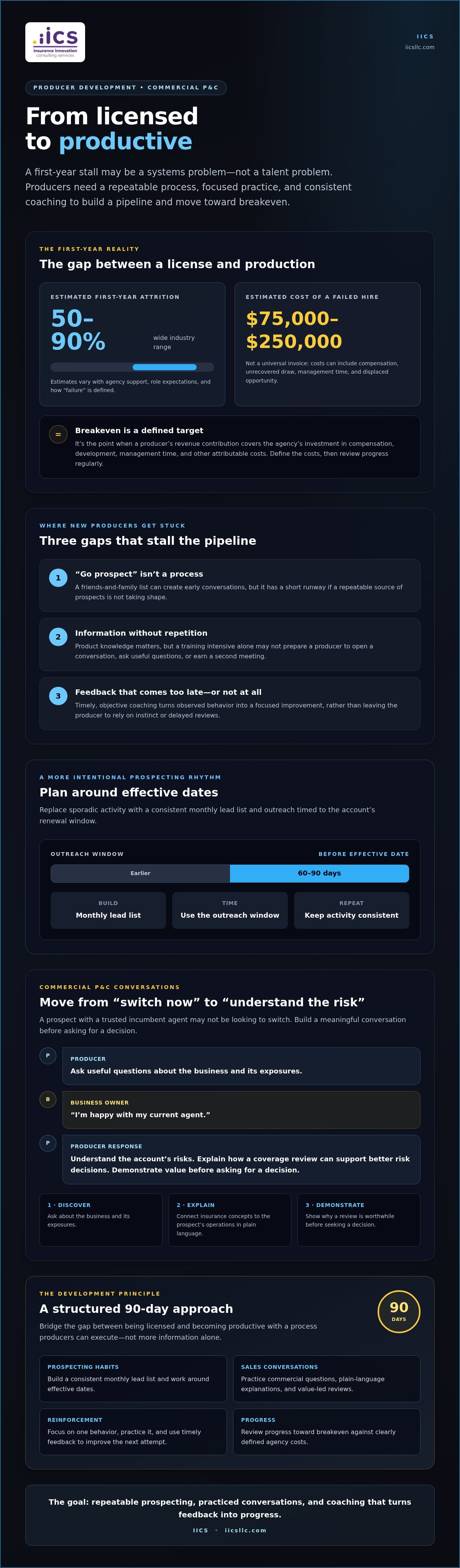
A producer can be licensed and enthusiastic and still struggle to generate revenue. That gap between qualification and production is where agencies absorb costs. Industry estimates put first-year attrition between 50% and 90%, a wide range that reflects differences in agency support, role expectations, and how “failure” is defined. The takeaway isn’t that every new hire is destined to wash out. It’s that licensing alone can’t show whether someone can prospect consistently, earn trust, and build a book.
That’s central to why insurance producers fail first year: agencies may hire for potential but leave the path to production undefined. The result can be costly for the business and demoralizing for the team. Colleagues see another promising hire stall, managers question their ability to develop talent, and the producer may interpret a weak pipeline as proof they don’t belong in the profession.
The True Cost of a Non-Producing Hire
Industry estimates place the cost of a failed producer hire between $75,000 and $250,000. That isn’t a universal invoice. The total can include compensation and draw expenses not recovered through new business, along with the opportunity cost of time diverted from agency growth. Principals and managers may spend hours reviewing activity, joining calls, and correcting preventable mistakes. If that time displaces client work or coaching other producers, the cost extends beyond payroll.
The breakeven point is when a producer’s revenue contribution covers the agency’s investment in their compensation, development, management time, and other attributable costs. Define those costs before setting a breakeven target, then review the producer’s progress against it regularly.
The effects can reach agency culture, too. A failed launch creates uncertainty about hiring decisions and makes remaining producers wonder whether the organization has a reliable development process. That’s a systems warning, not automatic proof that the hire lacked ability.
Why the “Friends and Family” Strategy Fails
Personal contacts can help a producer practice conversations and find early opportunities. But relying on that network as the entire prospecting plan creates a short runway. Once the most obvious contacts have been approached, activity can drop unless a repeatable pipeline is already taking shape. Referrals can contribute to growth, but they’re difficult to forecast or scale as the only source of new prospects. To establish consistent outreach beyond personal networks, teams often incorporate multi-channel social tools like SocialPosterr to engage and qualify prospects automatically.
Commercial P&C also demands more than taking an order from someone ready to buy. A producer must learn to ask useful questions, understand a prospect’s business exposures, and explain how a coverage review can support better risk decisions. That’s the shift from order taker to risk advisor. Strong sales effectiveness depends on turning preparation, discovery, and follow-up into consistent practice, not relying on charm or a warm contact list alone.
The 'Knowledge Firehose' and Why General Sales Training Fails
A three-day intensive can introduce a producer to a lot of information. It can’t, by itself, make new skills stick. When training ends without repetition, practice, and feedback, producers may remember product details but still be unsure how to open a prospect conversation, ask useful questions, or earn a second meeting. That’s the firehose effect: plenty of input, but too little supported practice to turn it into consistent action.
Generic advice like “Always Be Closing” can also misfire in commercial P&C. A business owner who already has coverage and a trusted agent isn’t waiting to be closed. Push for a quick switch, and the producer risks sounding interchangeable or opportunistic. The work is to uncover a meaningful reason for a conversation, understand the account’s risks, and demonstrate value before asking for a decision.
Product Knowledge vs. Sales Tactics
Knowing policy forms matters, but it won’t necessarily get a producer past a gatekeeper or help a business owner understand why a coverage discussion deserves time. Producers need to translate insurance concepts into plain language, connect questions to the prospect’s operations, and explain the purpose of a review without hiding behind jargon. Explore how the Inside the Academy development approach connects producer learning with practical sales development.
Learning also needs reinforcement. Rather than trying to memorize everything at once, producers can focus on one behavior, practice it in a real or coached conversation, and use the feedback to improve the next attempt.
Why “I’m Happy With My Current Agent” Isn’t the End
This objection is a real barrier, not a cue to attack the incumbent. A prospect may be satisfied because the relationship is responsive and familiar. A new producer can acknowledge that trust, then ask permission to explore whether anything has changed in the business, its operations, or its risk priorities. The aim is not to manufacture dissatisfaction. It’s to earn a relevant conversation and offer a clear reason to review the account.
Discipline Beats “Natural” Talent
Some producers appear naturally confident. But confidence without consistent activity won’t build a durable book. A repeatable process gives producers something to execute when motivation dips: prepare, reach out, ask, follow up, and review what happened. Building a $1MM+ book is an ambition, not an automatic result of forming habits. Habits create a foundation, but account fit, time, and execution still matter.
That’s why insurance producers fail first year when they’re left to wing it: without a clear process, each rejection can feel like a verdict instead of feedback. Replace improvisation with deliberate practice, and the incumbent barrier becomes a skill to develop rather than a reason to stop prospecting.
The Accountability Gap: AI Coaching vs. Instinct-Based Feedback
Training loses value when the producer returns to the desk with no clear way to practice or measure progress. A manager may review a call days later, recall only the most memorable moment, or offer feedback shaped by personal style. That advice can help, but delayed, inconsistent coaching makes it harder to identify which behavior to change in the next conversation.
This accountability gap helps explain why insurance producers fail first year even after receiving training: they may understand a concept without applying it consistently. Effective development connects instruction to practice, feedback, and another attempt. AI sales coaching can support a more consistent review process, while human mentors provide judgment, context, and guidance that technology alone can’t replace.
MicroLearning Turns Ideas Into Practice
A long seminar can introduce useful material, but exposure isn’t the same as retention or skill. MicroLearning breaks development into focused lessons producers can revisit and apply to their work. Instead of trying to absorb a firehose of information, a producer can concentrate on one sales behavior, practice it, and build on it over time.
Within a 90-day development plan, daily MicroLearning can make practice part of the working rhythm. IICS’s Sales Academy delivers 60 tactical modules as short daily video lessons, supported by coaching and structured development for P&C producers. The goal isn’t to promise permanent habit change from a set number of videos or modules. It’s to reinforce specific skills regularly and connect them to real producer activity.
Replace Instinct-Only Feedback With a Coaching Loop
AI coaching can help bring consistency to sales development by reviewing producer interactions against defined criteria and highlighting areas to work on. That can help a manager move beyond “I liked your approach” or “be more confident” toward concrete questions: Did the producer establish a reason for the conversation? Did they listen for relevant business needs? Did they agree on a clear next step? Any score should support coaching, not be treated as a complete measure of a producer’s potential.
Use the feedback loop deliberately:
Review: Identify one specific strength and one behavior to improve.
Practice: Rehearse the next conversation or follow-up.
Apply: Use the skill in prospect or client interactions.
Coach: Bring the experience to a 1:1 call-coaching session and refine the approach.
Weekly live workshops add peer accountability and experienced oversight, while 1:1 call coaching connects concepts to the producer’s actual conversations. AI coaching can make feedback more consistent, but it doesn’t replace a human mentor who can interpret context and help a producer prepare for the next call. That combination turns development from a one-time event into a repeatable system.
The 90-Day Tactical Blueprint: From Suspects to Sales
A 90-day plan turns prospecting from a vague instruction into a weekly operating rhythm. The objective isn’t to pressure every business into switching. It’s to identify accounts worth a conversation, approach them at a relevant time, and earn a clear next step. Track activity and follow-up so the pipeline doesn’t depend on memory or motivation.
Define the Strike Zone and Build the List
Start with commercial accounts that fit your agency’s appetite, expertise, and capacity to serve. Prioritize prospects whose operations you can understand and whose needs align with your market access. Build a suspect list by effective date, using IICS’s guidance of at least 100 leads per month. A lead source menu can include professional networks, dedicated lead providers like ClosrLeads, business directories, public business announcements, referral relationships, and industry events. Set a recurring weekly block to identify new names, then record the source, business type, contact details, and known or estimated renewal date. Keep the list current so follow-up is based on useful information, not memory.
The renewal buying window is the 30 to 60 days before a policy expires, when a business may be evaluating its coverage and renewal options. Begin outreach around 60 to 90 days before expiration. That gives you time to earn a conversation and understand the account before renewal decisions are underway.
Use Triggers and Lead With a Strong First Call
A Window Trigger Map connects a prospect’s effective date with business changes that may warrant a coverage conversation, such as expansion, new locations, changing operations, or newly introduced services. Treat each trigger as a reason to ask, not proof of a coverage gap. Keep research factual and verify AI-generated industry insights against reliable sources before using them with a prospect.
Frame the first call with a concise agenda: explain why you’re calling, ask permission to learn about the business, and agree on a next step if there’s a fit. On video or in person, use natural eye contact and pauses. On the phone, replace visual cues with clear questions and attentive listening.
Displace the Incumbent Without Attacking Them
When a prospect says, “I’m happy with my current agent,” respect the relationship. Ask a risk-focused question that invites reflection without manufacturing doubt: “Have your operations or priorities changed since your last coverage review?” Try these concise responses to common objections:
“We’re happy.” “I’m glad the relationship is working. May I ask what you value most about it?”
“We already have an agent.” “Understood. Would a second perspective be useful at renewal?”
“We’re not interested.” “No problem. Is there a better time to reconnect?”
“Just send information.” “Certainly. What would be most relevant to your business?”
“We’re too busy.” “I understand. Could we schedule a brief conversation for a more suitable time?”
“We just renewed.” “Thanks for letting me know. May I follow up ahead of the next renewal?”
“We’re reviewing other options.” “What matters most in your evaluation?”
“Your timing is off.” “When would a follow-up make sense?”
For producer development and background on the organization behind this approach, visit About IICS and its producer development approach.
Mastering Commercial P&C: The Sales Academy Solution
A license gets a producer into the profession. It doesn’t provide the daily practice, feedback, and prospecting discipline needed to build a book. The IICS Sales Academy is a 90-day development system for P&C producers, combining daily MicroLearning, AI sales coaching, and 1:1 mentoring. IICS states that its approach doubles the likelihood of success. That is a development objective, not a guarantee that every participant will become a top producer.
A 90-Day Structure for Producer Development
The three-month sequence develops core sales skills, pipeline activity, and selling execution through focused lessons and coaching. Producers first strengthen foundational sales behaviors, then apply them to consistent prospecting and pipeline development, and continue refining their approach through practice and feedback. Ninety days provides a focused period for building routines and reviewing progress. It isn’t a shortcut around the persistence required to earn commercial clients.
IICS brings a 40-year track record of producer growth and development to its work, including the experience of Ralph J. Blust and veteran sales mentors. The Academy’s practical value is in connecting instruction to real producer activity, so each call becomes an opportunity to apply and improve a specific skill. For a broader view of structured producer development, see the elite insurance producer development plan.
Measure Progress by Production, Not Activity Alone
Success requires more than completing lessons or logging outreach. Producers and agency leaders should review whether prospecting is consistent, conversations are improving, next steps are being secured, and pipeline activity is moving toward revenue. IICS reports that producers in its development approach can reach breakeven revenue in half the industry norm time. Treat this as the organization’s stated outcome, not an individual guarantee. Results depend on execution and other factors.
The key question behind why insurance producers fail first year is whether they receive a clear path from licensed to productive. A structured program can make expectations, practice, and coaching more deliberate, while the producer remains accountable for doing the work.
Explore the Sales Academy
The listed tuition is $3,000 per month. Invited agencies are offered a 50% discount, bringing tuition to $1,500 per month per student. The code provided for that offer is “Summer2026.” Because it is season-specific, agencies should confirm current eligibility and timing rather than assume it remains available.
If a 90-day development framework fits your agency’s needs, explore the IICS Sales Academy to review its producer-development approach.
Turn Producer Potential Into Consistent Production
The pattern behind why insurance producers fail first year is rarely a lack of ambition alone. Without a repeatable prospecting process, P&C-specific practice, and timely coaching, even a licensed, motivated producer can struggle to build a pipeline. A stronger approach pairs clear daily actions with regular feedback and development over time.
A structured 90-day program can help bridge the gap between licensed and productive through MicroLearning, AI sales coaching, and 1:1 mentoring. IICS brings a 40-year track record of growth and individual development to its Sales Academy, with a focus on helping producers build the skills and habits needed to pursue stronger results. No program can promise an individual outcome, but the right system gives producers a more deliberate way to improve.
Ready to replace guesswork with structured development? Explore the IICS Sales Academy and take the next step toward a more confident, consistent approach to commercial P&C sales. With focused practice and the right support, producers can build momentum one conversation at a time.
Why Insurance Producers Fail First Year
For agencies, the practical response is to make the producer’s path measurable: define the target account profile, build a list around effective dates, set regular prospecting and follow-up habits, and coach specific behaviors from real conversations. Producers need more than a launch-day information dump. They need focused practice and feedback that helps them improve the next call.
Frequently Asked Questions
How much does a failed insurance producer hire actually cost an agency?
There isn’t one fixed cost because it depends on compensation, time in the role, and the support provided. Agencies should account for salary or draws, onboarding and training, manager time spent coaching, and the opportunity cost of business that wasn’t pursued while those resources were tied up. Tracking these categories helps agency leaders assess the full impact and identify where a clearer development process could reduce avoidable losses.
Why do 70% of insurance agents fail in their first year?
That percentage shouldn’t be treated as a universal or definitive first-year failure rate. Estimates vary, and “failure” can mean different things. Common challenges include inconsistent prospecting, unrealistic expectations about ramp-up, weak coaching, and difficulty winning conversations with prospects who already trust an incumbent agent. This helps explain why insurance producers fail first year: a license and motivation don’t automatically create a repeatable sales process or a qualified pipeline.
What is the best sales training for commercial P&C producers?
The right training is built around commercial P&C sales, not just licensing or generic closing advice. Look for a program that combines practical sales skills with repeated practice, feedback, prospecting discipline, and mentorship. IICS’s three-month Sales Academy uses daily MicroLearning, AI Sales Coaching, 1:1 coaching, and weekly workshops. These elements are designed to help producers apply what they learn to real sales activity instead of relying on a one-time training session.
How many leads should a new insurance producer generate each month?
IICS’s producer-development guidance sets a minimum of 100 leads per month, organized around effective dates. Producers can use a suspect list to track each business, contact, expiration date, and follow-up. A lead count is an activity benchmark, not a promise of sales. Fit, outreach timing, and conversation quality still matter. Keep the list current and prioritize accounts that align with your agency’s commercial expertise and appetite.
What is the difference between a “suspect” and a “prospect” in insurance?
A suspect is a business that appears to fit your target profile but hasn’t yet been qualified through a meaningful conversation. A prospect is a suspect with a potential need, an appropriate fit, and some willingness to explore a discussion. For example, a business with a relevant effective date may belong on your suspect list. After you confirm its circumstances and interest, it may qualify as a prospect. Use the distinction to organize follow-up, not to assume a sale.
Can AI coaching really improve insurance sales performance?
AI coaching can support improvement by reviewing calls against defined criteria and offering timely feedback on areas such as questioning, listening, and next steps. It can help make coaching more consistent, but it doesn’t replace human judgment or mentoring. Producers should use the feedback to practice a specific behavior, apply it in another conversation, and review the result with a coach. Its value depends on how consistently the producer acts on the guidance.
How long does it take for a new insurance producer to become profitable?
There’s no single timeline. Profitability depends on the agency’s costs, sales cycle, target accounts, pipeline activity, and the producer’s development. IICS states that its structured producer-development approach can help participants reach breakeven revenue in half the industry norm time, but that is not a guaranteed result for every producer. Agency leaders should define breakeven clearly, set progress milestones, and review both sales activity and revenue contribution.
What is the “Summer2026” discount code for the Sales Academy?
“Summer2026” is the discount code listed for invited agencies seeking the IICS Sales Academy tuition discount. The stated offer is 50% off tuition, reducing the monthly amount from $3,000 to $1,500 per student for the three-month program. Eligibility is limited to invited agencies, so confirm that the offer applies to your agency before relying on it. The program combines MicroLearning, AI coaching, and mentoring for P&C producers.