Why Most Insurance Producer Academies Fail to Build Elite Talent in 2026
- Aug 1
- 12 min read
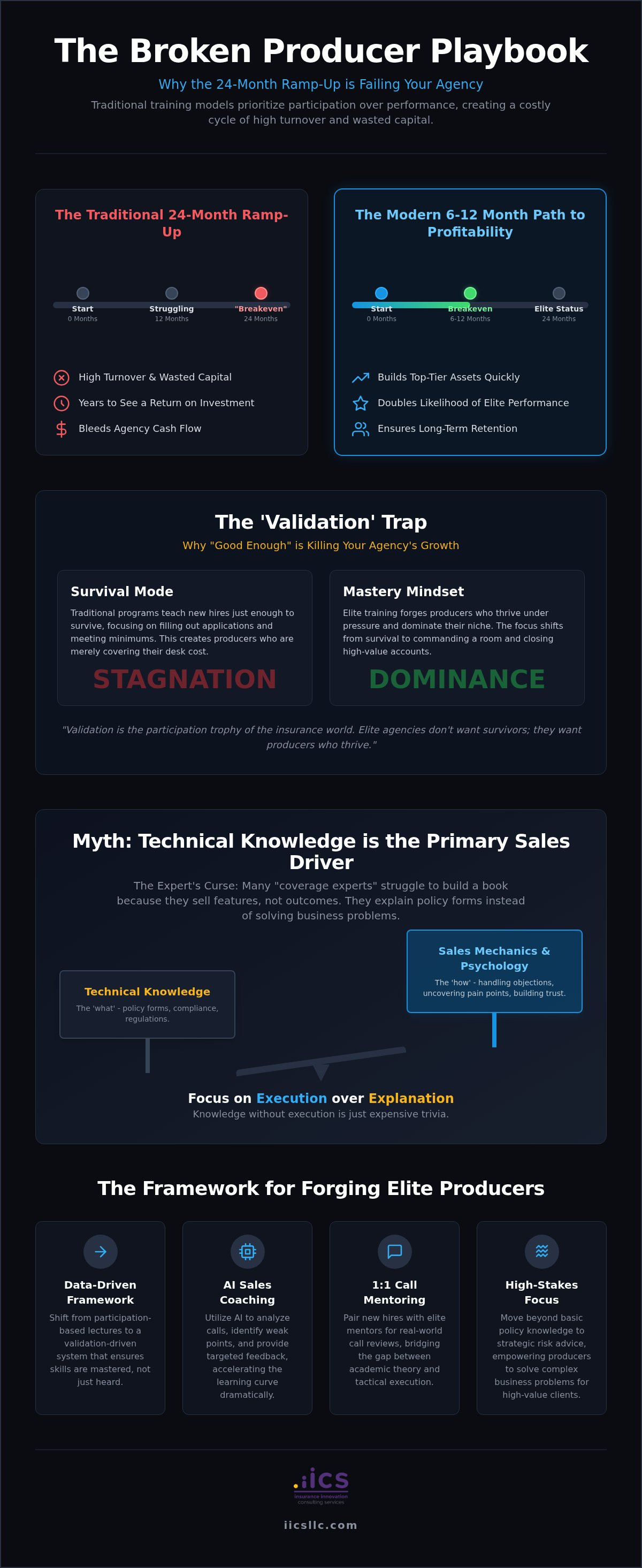
Why are you still settling for a 24-month ramp-up period that bleeds your agency dry? Most agency owners treat a new hire like a lottery ticket, hoping the standard insurance producer academy they have used for years will somehow spark elite performance. It won't. The reality in 2026 is that traditional training models are failing because they prioritize participation over validation. With nearly one in four insurance professionals aged 55 or older, the industry is desperate for talent, yet most programs still rely on outdated lectures that don't stick past Friday afternoon.
You know the frustration of watching a promising hire struggle to hit their numbers while your cash flow takes the hit. We agree that the current sink or swim mentality is a recipe for high turnover and wasted capital. This article exposes the myths holding your team back and introduces a data-driven framework designed to build elite P&C producers in half the industry-standard time. We will explore why AI-driven coaching and micro-learning are the keys to hitting breakeven in six to twelve months, ensuring your next hire becomes a top-tier asset rather than another expensive statistic.
Table of Contents
The 'Validation' Trap: Why Standard Insurance Producer Academies Are Failing Your Agency
Myth #1: Technical Product Knowledge is the Primary Driver of Sales Performance
Myth #2: Producer 'Ramp Up' Time is a Fixed Industry Standard
What to Look for in a Modern 2026 Insurance Producer Academy
The IICS Sales Academy: Forging the Elite P&C Producers of Tomorrow
The 'Validation' Trap: Why Standard Insurance Producer Academies Are Failing Your Agency
Validation is the participation trophy of the insurance world. When an agency owner tells me their producer is validated, they're usually telling me that the producer is doing just enough to stay employed. This is the Validation Trap. It's a dangerous plateau where growth stalls and agency capital evaporates. In the 2026 landscape, where liability rates continue to climb and AI is commoditizing basic service, a mediocre producer is a liability. Your insurance producer academy should be a forge for talent, not a finishing school for the average.
The first 90 days are the graveyard of most insurance careers. Why? Because most training programs focus on survival rather than mastery. They teach new hires how to fill out an application but fail to teach them how to command a room. When you settle for a producer who is merely surviving, you're paying for the privilege of stagnation. Elite agencies don't want survivors. They want producers who thrive under pressure and dominate their niche.
The Difference Between a Licensed Agent and an Elite Producer
A license is simply a permit to play. The regulatory role of an Insurance broker requires technical knowledge for compliance, but that knowledge doesn't close high-six-figure premiums. Standard academies confuse academic knowing with tactical doing. They produce graduates who can explain a policy form but can't handle a confrontational prospect. Production isn't about the policy; it's about psychology and discipline. High-stakes coaching bridges this gap by shifting the focus from technical jargon to the mechanics of the sale. It's about the grit required to make the next call and the precision needed to uncover a prospect's true pain points.
Why 'Minimum Standards' Are Killing Your Agency’s Growth
Why does the industry accept a 24-month ramp-up as normal? It's a drain on your agency’s capital that most owners simply ignore. This math of mediocrity assumes that a producer will eventually pay for themselves if you just wait long enough. You don't have two years to wait for a return on your investment in 2026. A surviving producer who merely covers their desk cost is a missed opportunity. Consider the hidden costs of a slow-moving insurance producer academy:
Opportunity Cost: Every lead a mediocre producer burns is a lead an elite producer would have closed.
Management Fatigue: You spend more time propping up underperformers than scaling your winners.
Cultural Rot: Low standards are contagious. They signal to your entire team that average is acceptable.
Elite performance must be the expectation from day one. If your current training model isn't accelerating the timeline to profitability, it's costing you more than just the tuition. It's costing you the future of your agency. Stop aiming for validation. Start aiming for dominance.
Myth #1: Technical Product Knowledge is the Primary Driver of Sales Performance
Most agency owners make a fatal assumption. They believe that if a producer understands the policy forms better than the competition, they will win the account. This is a lie. While technical competence is required, it's rarely the reason a prospect moves their business. In fact, many "coverage experts" struggle to build a book because they suffer from the Expert’s Curse. They spend thirty minutes explaining the nuances of an aggregate limit while the prospect is wondering if the producer actually understands their business operations. You don't need more walking encyclopedias; you need hunters who can translate risk into a business narrative.
Elite producers don't sell features. They sell outcomes. They understand that a policy is just a financial tool used to solve a larger strategic problem. When an insurance producer academy focuses 90% of its curriculum on technical designations and only 10% on the mechanics of the sale, it's setting your hires up for failure. The IICS Sales Academy rebalances this equation. We provide the technical foundation necessary for credibility, but we obsess over high-performance sales skills that move the needle. Knowledge without execution is just expensive trivia.
The Shift from Product Peddling to Strategic Risk Advice
The "quote and hope" mentality is a relic of a softer market. In 2026, prospects are exhausted by agents who promise to "save them 10%" without looking at their actual risk profile. To win at a high level, your producers must move beyond the policy and become strategic advisors. This requires a value proposition that isn't tethered to the lowest price. Strategic advice transforms insurance from a line-item expense into a competitive business advantage. When you lead with insight rather than a spreadsheet, you stop being a vendor and start being a partner.
How AI Sales Coaching Accelerates Execution Over Knowledge
Knowing what to say is easy. Saying it under pressure during a $50,000 revenue presentation is where most producers crumble. Traditional training fails because it can't replicate the stress of a real-world interaction. Recent research on training effectiveness highlights that legacy models have reached a plateau, demanding technological intervention to break through. This is why we leverage AI Sales Coaching to provide data-driven feedback on tone, pace, and objection handling.
AI doesn't just tell a producer they were "good." It shows them exactly where they lost the prospect's interest or where their voice lacked authority. This real-time feedback loop is ten times more effective than an annual review or a generic group webinar. It bridges the gap between academic policy knowledge and the raw discipline required to close the deal. If you want to see how modern sales methodologies can transform your team, you have to look beyond the textbook. Stop training your people to be experts in insurance and start training them to be experts in winning.
Myth #2: Producer 'Ramp Up' Time is a Fixed Industry Standard
The 24-month ramp-up is a myth designed to comfort mediocre managers. For decades, the industry has accepted that it takes two years for a new hire to pay for their own desk. This is not a law of physics. It's a failure of methodology. If your insurance producer academy tells you to wait two years for a return on your investment, they're managing your expectations down to their level of incompetence. Every month your producer spends "finding their rhythm" is a month of hemorrhaging agency capital. The math is unforgiving.
The "sink or swim" method is not a strategy. It's an expensive gamble. When you hire a producer and leave them to figure it out, you're losing more than just their base salary. You're losing the market share they should have captured. A 3-month intensive model works because it creates immediate pressure and provides the tactical tools to handle it. More time doesn't equal more talent. It just equals more overhead. We've proven that elite P&C producers can reach breakeven in half the industry-standard time by focusing on execution over mere attendance.
The ROI of Compressing the Learning Curve
Stop viewing training as a tuition expense. It's a capital investment with a measurable yield. A producer who validates in 12 months instead of 24 adds a full year of pure profit to your bottom line. Agency principals must shift their perspective and start seeing development as a multiplier for agency value. For a deeper dive into the numbers, read The ROI of Elite Performance: A Guide to Insurance Sales Training Programs in 2026. When you compress the learning curve, you don't just save money. You gain the momentum required to dominate your local market.
MicroLearning: The Science of Accelerated Retention
Why are you still subjecting your team to 8-hour classroom sessions? Human brains aren't built to absorb complex insurance jargon for a full workday. Most of that information is forgotten before the first afternoon break. We utilize MicroLearning because it respects the science of how elite performers actually retain information. Bite-sized, actionable modules allow producers to learn a concept and apply it to a real prospect within the hour.
This approach keeps your producers in the field where the revenue is. An elite insurance producer academy doesn't pull your talent out of the market for weeks on end. It sharpens them while they're in the heat of the hunt. By delivering high-impact training in small doses, we ensure the knowledge sticks and the sales process becomes second nature. Execution is the only metric that matters.
What to Look for in a Modern 2026 Insurance Producer Academy
Selecting an insurance producer academy is a high-stakes strategic decision. It is the difference between building a scalable asset and managing a revolving door of talent. In 2026, the market is too competitive for generic sales tips or surface-level webinars. You need a battle-tested framework that produces elite results with surgical precision. Don't settle for a library of videos. You need a partner that provides data-driven feedback on actual sales calls, allowing your producers to adjust their strategy before the next meeting.
To secure a top-tier return on your investment, follow these five steps. First, prioritize individual 1:1 call coaching. Group sessions are fine for general concepts, but real growth happens when a coach dissects a producer’s specific interactions. Second, demand data-driven feedback through AI sales coaching. This technology allows for objective analysis of tone and objection handling that a human might miss. Third, look for a 40-year track record of growth. Experience matters. Fourth, ensure the focus is strictly on Commercial P&C. Generic training won't help a producer navigate complex liability risks. Finally, verify that mentorship extends beyond the initial classroom phase. Elite performance requires ongoing refinement.
The Essential Role of 1:1 Call Coaching and Mentoring
Role-play is the most underutilized tool in the industry. It is the only way to build the muscle memory required for high-stakes negotiations. A standard trainer will tell you what to do; an elite performance coach will show you how to do it. We use 1:1 mentoring to refine individual producer strengths and eliminate the habits that kill deals. We don't just teach the process; we coach the execution. This level of personalized attention ensures that every producer develops the discipline needed to dominate their specific niche.
Integrating Weekly Live Workshops into Daily Activity
Habits aren't formed in a weekend. They are forged through consistent, weekly live workshops that keep producers engaged with the material. These sessions provide a platform for real-time problem solving and peer-to-peer learning. To ensure these habits stick, we provide Effectiveness Tools that manage a producer’s daily workflow. This systematic approach ensures that training isn't a distraction from sales activity, but the engine that drives it. If you are ready to stop gambling on your agency’s future, apply for The Sales Academy today.
The IICS Sales Academy: Forging the Elite P&C Producers of Tomorrow
The IICS Sales Academy is not just another insurance producer academy. It is a high-stakes forge for agency owners who refuse to settle for average results. While the rest of the industry accepts a 24-month ramp-up as an unchangeable reality, we have spent 40 years proving otherwise. Our 3-month intensive Sales Academy for property and casualty Insurance Producers is designed to compress a career’s worth of growth into a single quarter. We don't just provide information; we demand transformation. By combining a multi-decade track record with modern technology, we provide the stable foundation your agency needs to scale in an increasingly volatile environment.
The synergy of our methodology is what sets us apart. By combining MicroLearning with AI Sales Coaching and 1:1 Mentoring, we create an environment where learning is immediate and feedback is constant. This isn't a passive webinar series. It is a rigorous, data-driven process that doubles the likelihood of your new hires becoming top-tier performers. We bridge the gap between knowing and doing by providing the effectiveness tools and the high-performance coaching required to close complex P&C accounts. Your producers will hit breakeven in half the industry norm time because they are trained to solve business problems, not just peddle policies.
Your Path to Elite Performance Starts Here
Integrating a modern insurance producer academy into your existing agency onboarding doesn't have to be a disruptive event. Our methodology is designed to complement your daily operations by keeping producers in the field while they sharpen their skills. We provide a structured roadmap that takes a producer from day one to high-level execution without the struggle phase that ruins most careers. To understand the full scope of our methodology, explore our Insurance Producer Academy: 2026 Elite Development Guide. This resource outlines exactly how we bridge the gap between compliance and dominance through a systematic, repeatable sales process.
Take the Next Step Toward Agency Growth
Stop settling for producers who are merely validated. In the 2026 market, validation is a minimum standard that barely covers your overhead. You need elite talent that drives agency value and captures market share from competitors who are still relying on outdated training models. Whether you need our 3-month intensive Sales Academy or our fractional CRO services to overhaul your sales culture, the time to act is now. The cost of stagnation is far higher than the investment in excellence. Apply for the IICS Sales Academy today and start building the elite team your agency deserves.
Secure Your Agency’s Future with Elite Performance
The 24-month ramp-up is a choice, not a requirement. The evidence is clear: the validation trap and an over-reliance on technical knowledge stifle agency growth. To thrive in 2026, you must demand a training model that prioritizes psychological discipline and tactical execution. Choosing the right insurance producer academy is a strategic investment in your firm’s survival. It's the difference between a producer who merely covers their desk and one who dominates the market.
We provide a 40-year track record of elite development, combining high-stakes 1:1 mentoring with cutting-edge AI-driven coaching. Our framework ensures your new hires reach breakeven in 50% less time than industry standards. Stop gambling on "sink or swim" tactics and start building a systematic engine for success. Your agency’s potential is only limited by the standards you set for your talent.
Double your producer's success rate with the IICS Sales Academy. You have the tools to build an elite team; now it's time to use them.
Frequently Asked Questions
What is an insurance producer academy?
An insurance producer academy is an intensive development program designed to transform new hires into revenue-generating assets through specialized sales training. Unlike basic licensing courses, a high-performance academy focuses on the mechanics of the sale, risk advisory, and systematic business development. It provides the framework necessary for producers to move beyond technical knowledge and master the psychology of closing complex property and casualty accounts.
How long does it take to train a new insurance producer?
Traditional industry standards suggest a 24-month ramp-up period, but an elite framework can compress this timeline to just three to six months. By utilizing intensive coaching and MicroLearning, producers can reach breakeven in half the industry norm time. Speed to market is critical in 2026. Agencies that accept year-long struggle phases are simply losing capital to competitors who prioritize rapid validation and elite execution.
Is AI sales coaching effective for experienced producers?
Yes, AI coaching is highly effective for veterans because it identifies subtle performance plateaus that human observation often misses. Even seasoned producers develop bad habits in their tone, pace, or objection handling over decades. Data-driven feedback provides objective evidence of where a veteran’s pitch is losing its edge. This allows them to refine their approach with surgical precision, ensuring they maintain their elite status in a shifting market.
What is the difference between a carrier school and a sales academy?
Carrier schools focus primarily on product technicalities and underwriting guidelines, while a sales academy focuses on the discipline of winning new business. Knowing policy forms is a minimum requirement, but it doesn't close deals. An elite academy bridges the gap between technical expertise and sales psychology. It transforms coverage experts into strategic risk advisors who can command high-revenue accounts and drive agency growth.
How do you calculate the ROI of an insurance producer academy?
You calculate ROI by measuring the acceleration of the producer's breakeven point and the total revenue generated compared to the training investment. If a producer validates in 12 months instead of 24, the agency gains a full year of profitable production. You must also factor in the opportunity cost of lost leads. A systematic insurance producer academy doubles the likelihood of a hire becoming a top-tier performer, significantly increasing long-term asset value.
Can a producer academy help with Commercial P&C specifically?
Yes, specialized academies are essential for Commercial P&C because the sales cycle is more complex and involves higher stakes than personal lines. Commercial producers must understand business risk, liability nuances, and executive-level decision-making. A program focused on P&C provides the specific effectiveness tools needed to navigate these technical waters. It ensures that producers aren't just selling a policy, but are offering strategic business solutions that protect a client’s bottom line.
What is MicroLearning in the context of insurance sales?
MicroLearning is the delivery of training in bite-sized, actionable modules that producers can consume and apply immediately in the field. Instead of wasting eight hours in a classroom, producers learn a specific tactic in ten minutes and use it on their next prospect call. This methodology respects modern learning science, ensuring higher retention rates. It allows producers to remain active in the hunt while continuously sharpening their tactical skills.
Why do most new insurance producers fail within their first year?
Most producers fail because they are victims of the Validation Trap and the sink or swim mentality. Agencies often provide technical knowledge but fail to provide a repeatable sales process or high-stakes coaching. Without a systematic framework to handle objections and build a pipeline, new hires crumble under the pressure of the first 90 days. Failure is usually a result of poor methodology, not a lack of potential talent.